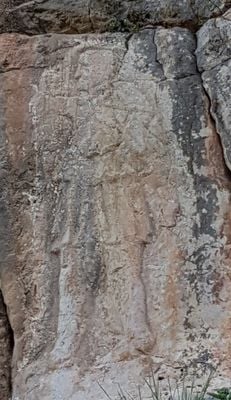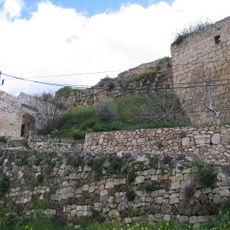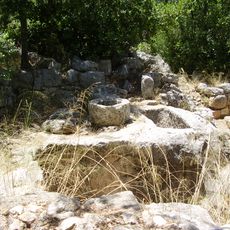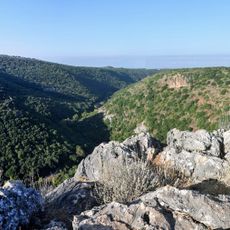
The man in the wall, Relief sculpture in Nahal Kziv, Israel
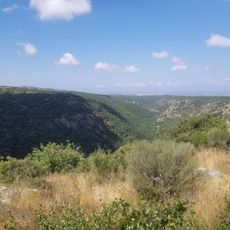
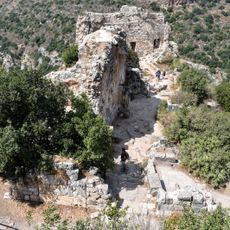
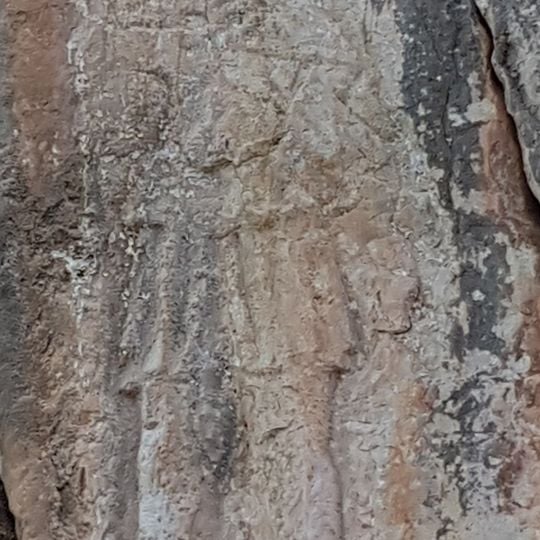
The Man in the Wall is a relief of a male figure, probably a Roman soldier, carved in Hellenistic style into a cliff wall about 3 meters to the right of the entrance of the Temple cave (Al-Jalila cave), on the steep northern slope above Nahal Kziv, roughly two kilometers west of Abirim. The figure, about 1.5 meters tall, wears a pleated dress draped over one arm, has muscular legs and a raised right hand, with a dagger sheath at its left and probably a helmet on its head.
The relief was found in 1985 by Shmuel Beer during an archaeological survey of the caves in the Nahal Kziv cliff. Its location was kept secret for several years until a trail was marked to it, and in 1992 the Israel Antiquities Authority prepared a copy. Pottery from the nearby Temple cave dates the carving to the Hellenistic period; similar reliefs are known from Lebanon and Syria but not elsewhere in Israel.
The figure is carved in Hellenistic style, yet comparable reliefs have been found in Lebanon and Syria, not elsewhere in Israel. Its name in Hebrew, Ha'ish Shebakir, simply means "the man in the wall". Visitors reach it on a marked trail above Nahal Kziv, about two kilometres west of Abirim.
The relief sits about 3 m to the right of the entrance of the Temple cave (Al-Jalila cave), on the steep northern slope above Nahal Kziv, roughly 2 km west of Abirim. A marked trail leads to it, laid out by the trail marking committee after the site became public. The figure is about 1.5 m tall, so look up at the rock face rather than at eye level.
The relief was found in 1985 by Shmuel Beer during an archaeological survey of the Nahal Kziv cliffs. Its location was kept secret for several years until a marked trail was established, and in 1992 the Israel Antiquities Authority prepared a copy of the carving.
The community of curious travelers
AroundUs brings together thousands of curated places, local tips, and hidden gems, enriched daily by 93,283 contributors worldwide.