Tsavo East National Park, National park in southern Kenya.
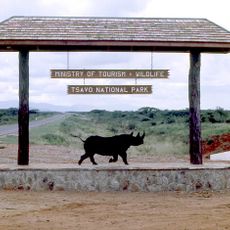
Tsavo East National Park covers 13,747 square kilometers of generally flat, semi-arid plains in Taita-Taveta County, Kenya. The Galana River crosses these dry grasslands and savanna, and the Yatta Plateau, a 290-kilometer lava ridge formed by Ol Donyo Sabuk Mountain, runs along the western boundary. At the entrance, a low stone platform supports a shingled roof on two rough wooden posts, with brown signs reading "MINISTRY OF TOURISM & WILDLIFE" and "TSAVO NATIONAL PARK".
Tsavo was gazetted as a national park on 1 April 1948, covering 21,812 km²; in May 1949 it was split into Tsavo East and Tsavo West for administrative reasons. The Orma pastoralists and Watha hunter-gatherers lost their settlements when the park was created. In 1898 two man-eating lions halted construction of the Uganda Railway, and the railway was eventually completed to Kisumu on Lake Victoria.
The park's name comes from the Tsavo River, which flows through it. The red elephants of Tsavo get their colour from the park's red earth, which they dust onto themselves during dust or mud baths. The elephant Dida, known for her long tusks and called the "Queen of Tsavo", lived here until her death in 2022.
The reserve offers several accommodations along its borders with access through the nearby town of Voi in Taita-Taveta County. The best months for wildlife viewing fall during the dry seasons when herds gather at water points and visibility improves through lower vegetation.
The lions of Tsavo East display a distinct feature: the adult males lack the typical mane found on lions elsewhere. This characteristic may relate to the hot climate and dense vegetation that favor a cooler body temperature.
The community of curious travelers
AroundUs brings together thousands of curated places, local tips, and hidden gems, enriched daily by 94,531 contributors worldwide.