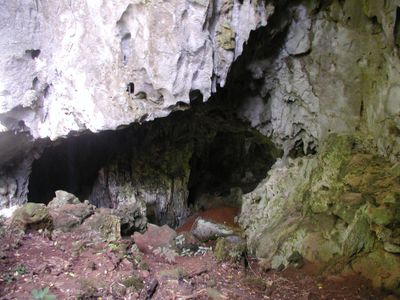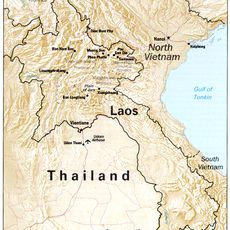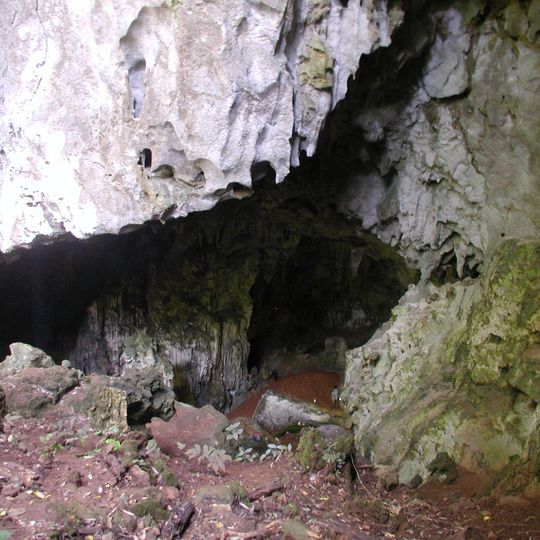
Tam Pa Ling Cave, Archaeological cave on Pa Hang Mountain, Annamite Mountains, Laos.
Tam Pa Ling is a karst cave in the Annamite Mountains of Houaphanh Province, northeastern Laos, with a single south-facing entrance. The main gallery lies 65 meters below the opening and measures 30 meters north to south by 40 meters east to west. The cave formed in limestone laid down between the Upper Carboniferous and Permian periods.
Excavations began in 2009 at the eastern end of the main gallery, led by American, French and Laotian researchers. The skull TPL1 was recovered in December 2009 at a depth of 2.35 m; the mandible TPL2 followed in 2010 and TPL3 in 2013. Dating placed the fossils between roughly 70,000 and 46,000 years old. In April 2016 they were returned to Laos and are housed in the Lao National Museum in Vientiane.
Tam Pa Ling means "Cave of the Monkeys" in Lao, a name linked to the primates of the Annamite Mountains. The cave lies in Houaphanh Province, and its Lao name is written ຖ້ຳຜາລິງ. The fossils are now kept at the Lao National Museum in Vientiane.
Visiting the cave requires a knowledgeable guide and good physical fitness because of its location at 1,170 meters elevation in northeastern Laos. Prepare for rough terrain and a challenging hike to reach the entrance.
The TPL1 skull, found in December 2009 at a depth of 2.35 m, has features described as Sub-Saharan African and is the earliest skeletal evidence of Homo sapiens in mainland Southeast Asia. The fossils were taken to the United States for study and returned to Laos in April 2016; they are now held at the Lao National Museum in Vientiane.
The community of curious travelers
AroundUs brings together thousands of curated places, local tips, and hidden gems, enriched daily by 95,648 contributors worldwide.