Кізитиринське городище, Archaeological hillfort in Rostov-on-Don, Russia.
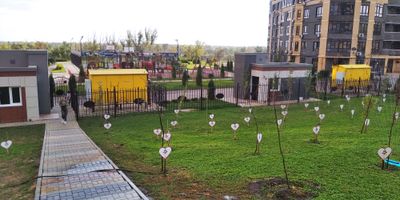
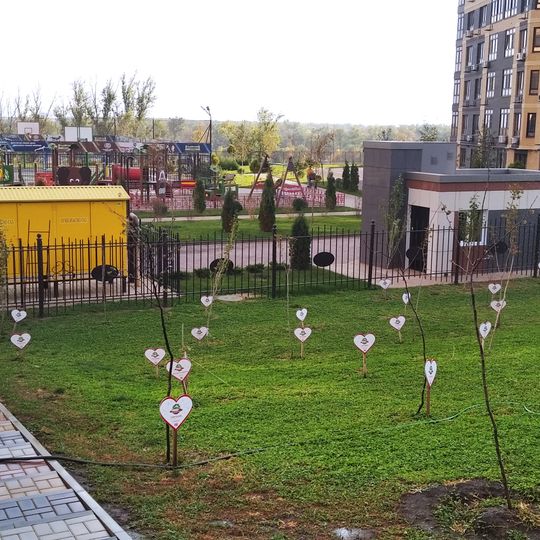
Кізитиринське городище is a buried Meotian settlement of the 1st century BCE–2nd century CE on a high cape formed by the right bank of the Don and the slope of the Kiziterinskaya gully in Rostov-on-Don's Proletarsky district. The square site covers 10,000 square metres, but most of it lies under the Krasny Aksay plant and the Yasnaya Polyana workers' settlement, so no earthworks are visible; the photograph shows only a fenced grassy lot with saplings marked by white heart-shaped signs.
Founded by the Maeotians at the start of the 1st century CE on a cape above the Don, the settlement covered 10,000 square metres and housed 400–500 people. It was linked to the Rostov and Temernik hillforts and underwent Sarmatisation, especially from the mid-2nd century CE. It ceased to exist after nomadic invasions in the early centuries CE.
The name comes from the Kiziterinka gully where it meets the Don. The Meotians who lived here were settled farmers and fishers, growing millet, barley and wheat and catching sturgeon, catfish and pike-perch in the river. Their position on trade routes made them dealers in glass beads and ornaments from Egypt, Iran and Persia, and from the mid-2nd century CE they were increasingly influenced by neighbouring Sarmatian tribes.
The settlement lies buried under the Krasny Aksay plant and the Yasnaya Polyana workers' settlement in Rostov-on-Don's Proletarsky district, at the western end of 5th Street near the Kiziterinka stream's mouth. No excavated remains or earthworks are visible, and the photograph shows only a fenced lawn with young trees. Unauthorised clay and stone extraction has left pits on the territory.
The site lies buried under the Krasny Aksay plant and the Yasnaya Polyana workers' settlement, so no earthworks are visible; the photograph shows only a fenced lawn with young trees marked by white heart-shaped signs. In 1927, clay digging here exposed a burial ground with an intact narrow-necked amphora about 74 cm tall and roughly 5 litres in capacity, made of fine yellowish-pink clay.
The community of curious travelers
AroundUs brings together thousands of curated places, local tips, and hidden gems, enriched daily by 95,141 contributors worldwide.