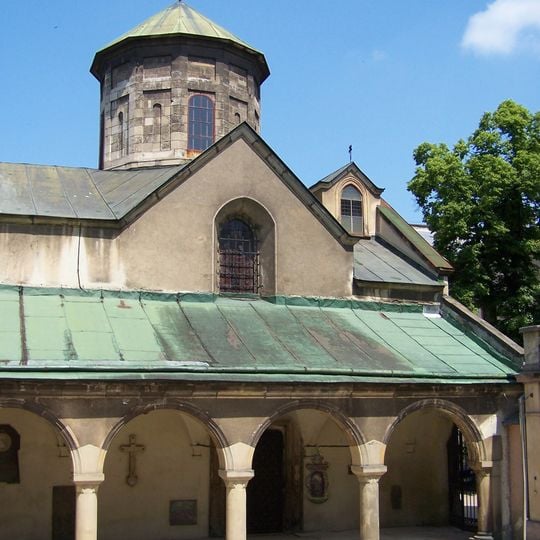
Armenian Cathedral of Lviv, Medieval cathedral in Old Town, Ukraine.
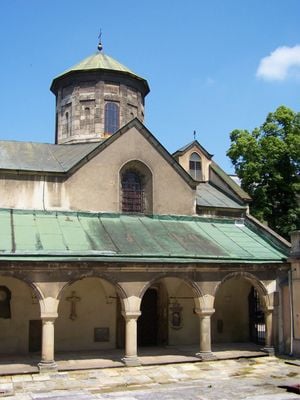
The Armenian Cathedral is a stone structure featuring a twelve-sided drum, open arcade galleries, and medieval tombstones with Armenian inscriptions scattered across the courtyard. The design combines classical Armenian architectural elements with European influences from the late medieval period.
Construction took place between 1363 and 1370 under architect Doring, serving as a religious center for Armenian merchants who controlled eastern trade routes. This building emerged from a broader Armenian diaspora movement in Europe during the late medieval period.
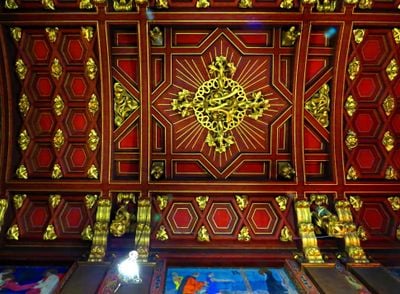
The cathedral has been the religious and community centre of Lviv's Armenians since 1367, when it became the seat of the Armenian diocese of Rus and Wallachia. In the courtyard stands a column with a figure of Saint Christopher from 1726, and a khachkar carved in Armenia was placed there in 2005 for the 90th anniversary of the 1915 Armenian genocide. The wooden ceiling over the nave, made in the 17th century, was given its red and gold panelled form during the 1908–1927 restoration.
The complex is accessible through entrances on Virmenska Street and Lesya Ukrainka Street, allowing visitors to approach from different directions. You can spend time exploring both the interior spaces and the courtyard with its medieval tombstones at a comfortable pace.
In summer 1978 the cathedral courtyard served as the set for the duel scene in the film D'Artagnan and Three Musketeers. A khachkar carved by stonemasons in Armenia was placed in the inner courtyard in 2005, on the 90th anniversary of the 1915 Armenian genocide.
The community of curious travelers
AroundUs brings together thousands of curated places, local tips, and hidden gems, enriched daily by 94,712 contributors worldwide.