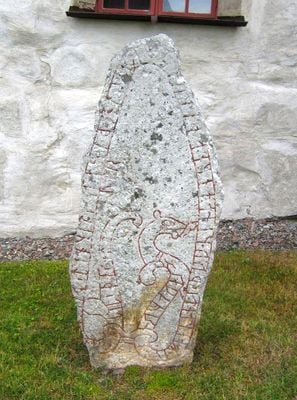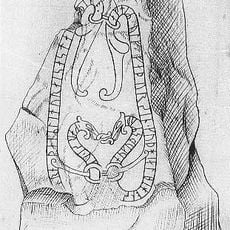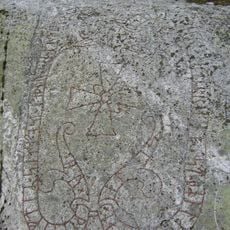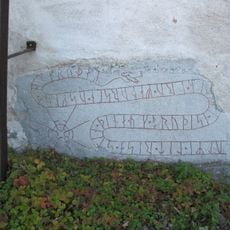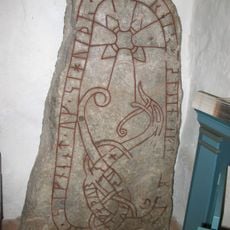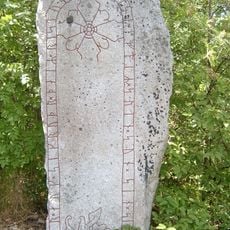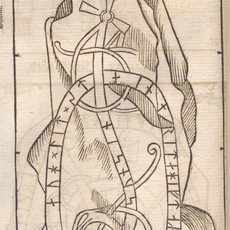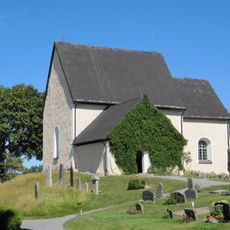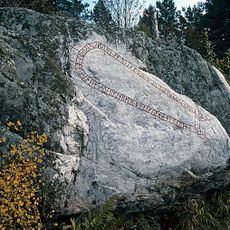
Orkesta Runestone, Norse runestone at Orkesta Church, Sweden.
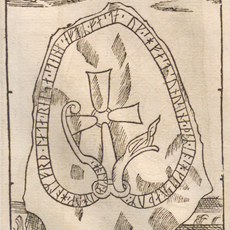
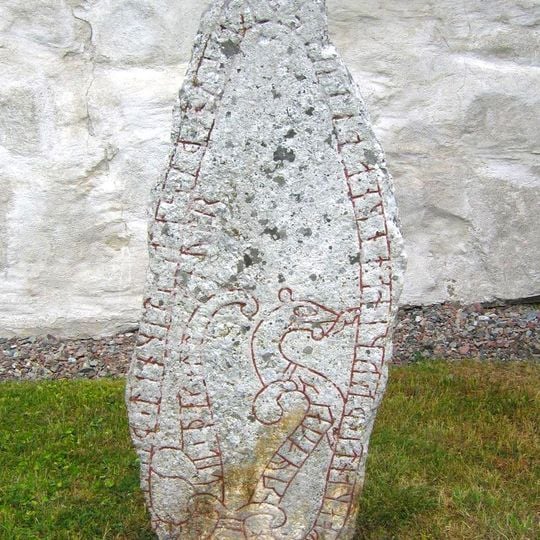
The Orkesta Runestone is an 11th-century monument positioned near Orkesta Church, displaying carved inscriptions in younger futhark characters. The stone records names, family connections, and personal accomplishments through its Old Norse text.
U 344 was found in 1868 by Richard Dybeck at Yttergärde and re-erected at Orkesta Church in 1977. Its inscription records that Ulf of Borresta took three danegelds in England: with Skagul Toste, with Thorkell the Tall in 1012, and with Canute the Great in 1018. The runes are mirror-reversed and read right to left, except the name Knutr.
U 344 is one of the England runestones, a small group that names danegeld payments taken in England. Its text lists three: first with Skagul Toste, then Thorkell the Tall in 1012, and finally Canute the Great in 1018. The runes are carved as mirrored turn-runes read from right to left, except the name Knutr outside the band, written left to right in normal runes.
U 344 now stands at the western entrance of Orkesta Church, where it was re-erected in 1977 after Richard Dybeck found it in 1868 at Yttergärde. The runes are carved as reversed (mirror-image) runes, and the band is read from right to left; only the name Knutr, outside the band, is written left to right in normal orientation. There are no word separators or punctuation marks between the words.
U 344 is one of the England runestones, a small group of Swedish stones naming danegeld payments. Its text lists the three leaders Ulf of Borresta followed: Skagul Toste, Thorkel the Tall and Canute the Great. The last name, knutr, sits outside the rune band, cut in normal left-to-right orientation while the rest runs mirrored from right to left.
The community of curious travelers
AroundUs brings together thousands of curated places, local tips, and hidden gems, enriched daily by 93,856 contributors worldwide.