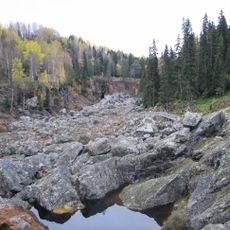
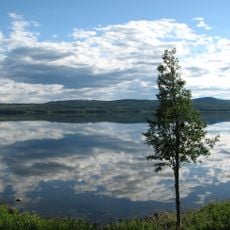
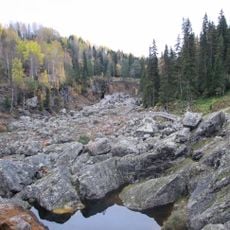
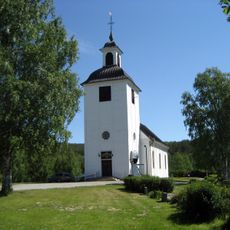
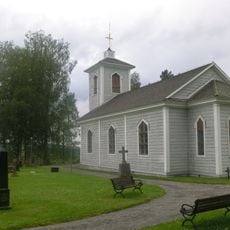
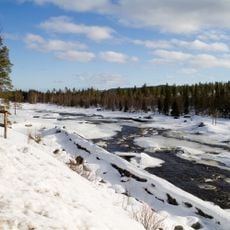
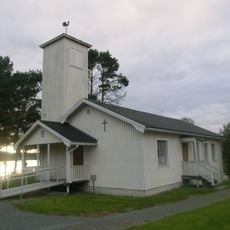
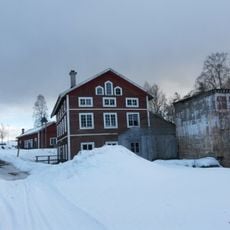
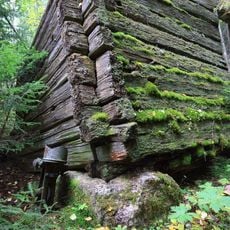
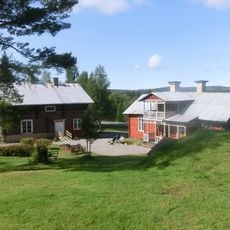
Hammarforsen, Whitewater rapids on Indalsälven river, Ragunda Municipality, Sweden.
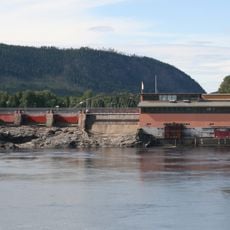
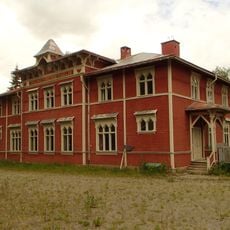
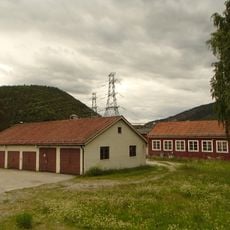
Hammarforsen is a rapid on the Indalsälven in Ragunda Municipality, about one kilometre upstream of the dry Döda fallet. It appeared in 1796 when the river changed course, and since 1928 its flow has been regulated by Hammarforsens kraftverk, whose functionalist building was designed by Osvald Almqvist.
Hammarforsen is Sweden's youngest waterfall, created on the night of 6–7 June 1796 when Magnus Huss, known as Vildhussen, cut through the gravel ridge holding back Ragundasjön. About 300 million cubic metres of water drained in some four hours, Indalsälven changed course, Gedungsen fell silent as Döda fallet, and the new rapids appeared about a kilometre upstream. Since 1928 the Hammarforsen power station, designed by Osvald Almqvist and built by Kreuger & Toll, has regulated the flow.
The name Hammarforsen refers to the rapids by Hammarstrand, and the site is tied to the 1796 disaster: the local sheriff Haqvin Frisk described the devastation with the words "Här ser riktigt ut som om den onde farit fram med en snöplog." The dried-out Storforsen, now Döda fallet, became one of Ragunda Municipality's biggest tourist attractions, while Hammarforsen itself has been regulated by its power station since 1928.
The site can be visited from several viewing and access points, though some spots are more easily reached than others depending on river conditions. It is best to check water levels beforehand and wear appropriate footwear, as the rocks can be slippery and conditions change with the seasons.
Hammarforsen is often called Sweden's youngest waterfall: it appeared only in 1796, when the engineer Magnus Huss, known as Vildhussen, cut through the gravel ridge holding back Ragundasjön. The lake emptied in about four hours, some 300 million cubic metres of water, and the Indalsälven took a new course.
The community of curious travelers
AroundUs brings together thousands of curated places, local tips, and hidden gems, enriched daily by 94,815 contributors worldwide.