Gloucester Cathedral, Anglican cathedral in Gloucester, England
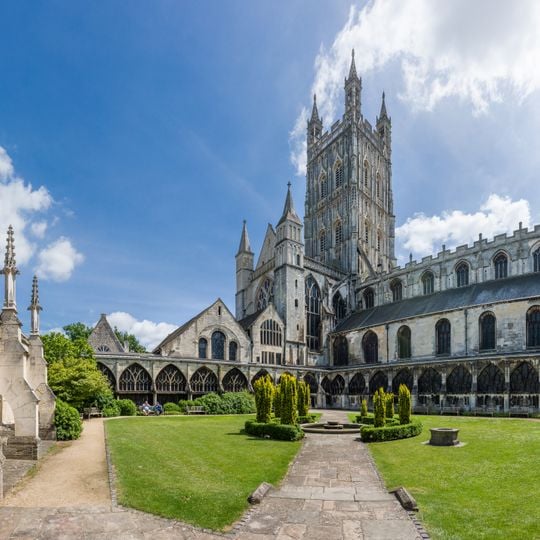
Gloucester Cathedral is a large Gothic stone building of pale grey stone, with a tall square tower topped by corner pinnacles and tiered pointed openings. To its left a lower gabled section holds a large pointed window, and a lower wing with arched windows runs beneath a battlemented parapet. A cloister walk of dark pointed arches surrounds a lawn, and the stonework shows areas of darker weathering.
Osric, King of the Hwicce, founded a minster here around 679; Benedictine monks took over in 1022. After a fire in 1088, Abbot Serlo began the present church in 1089, and William the Conqueror held his Christmas court in the chapter house in 1085, ordering the Domesday Book. Henry III was crowned here in October 1216, and Edward II was buried in the abbey in 1327. The abbey became a cathedral in 1536.
The cathedral is dedicated to St Peter and the Holy and Indivisible Trinity, and its formal name recalls the Benedictine abbey refounded as a cathedral in 1536. In the choir, the large east window was funded by nobles who fought at the Battle of Crécy in 1346, which is why it is called the Crécy Window. The cloister's fan vaulting was built between 1351 and 1412.
The cathedral stands in the old town about 500 m west of the River Severn, and the main entrance today is the south-west porch built in the early 15th century. The building is about 123 m long and 42 m wide, with a crossing tower of roughly 68 m from the 15th century. The cloisters lie south of the nave, and the four cloister walks were built between 1351 and 1412.
The east window, about 25 m high and 12 m wide, was glazed between 1347 and 1349 and is known as the Crécy Window because nobles who fought at the Battle of Crécy in 1346 paid for it. Its central subject is the Coronation of the Virgin.
The community of curious travelers
AroundUs brings together thousands of curated places, local tips, and hidden gems, enriched daily by 93,360 contributors worldwide.