Castellet de Carrícola, Medieval castle in El Palomar, Spain
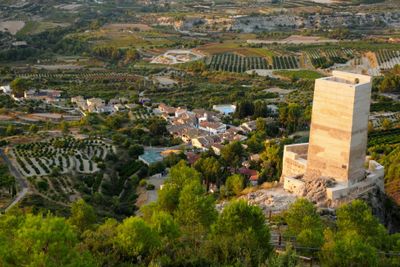
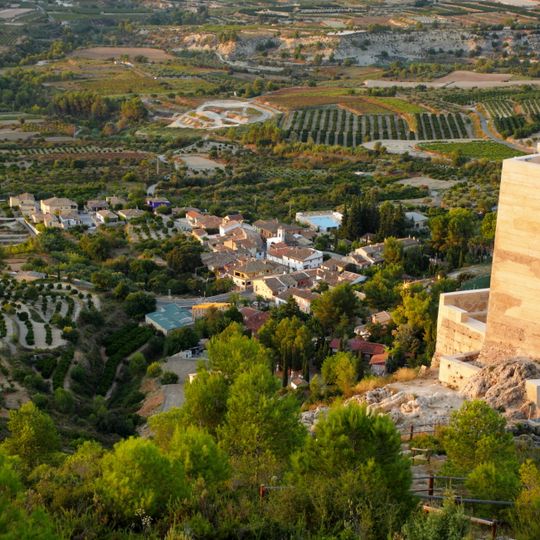
Castellet de Carrícola is a small late-Andalusian fortress on the left slope of the Barranc del Castellet, in the Ombría del Benicadell protected area at 415–420 m. Its irregular polygonal tower (sides 7.39, 6.60, 5.20 and 5.23 m; height 10.6 m) was built with rammed-earth boxes 85 cm high and 65 cm wide, and is enclosed by a small walled courtyard with a walkway.
The first documentary mention dates from 1258, when the Royal Chancery recorded the fortress as castrum Montes, guarding the alquerías of Carrícola and Muntis. A 1259 document calls it a tower built by the Muslim inhabitants using rammed-earth formwork. The Catalan knight Ramon de Timor received these lands from James I of Aragon, and the stronghold later passed to the barony of Albaida before being abandoned. Restoration was completed in 2011.
The tower was built by the Muslim inhabitants of Carrícola and the vanished hamlet of Muntis using Andalusi rammed-earth formwork, with caissons 85 cm high and 65 cm wide. The site appears in royal chancery records of 1258 as castrum Montes and in 1259 as turris, and the Muslim vassals supplied its garrison and provisions.
The tower stands on the left slope of the barranc del Castellet, in the shady Ombría del Benicadell, at 415–420 m, reached on foot; the access stair and the floor inside have disappeared, so the upper level cannot be climbed. The main door with its damaged arch faces east, and a second entrance lies on the steep lower side. Restoration was completed in 2011.
Excavations revealed that the base of the structure measures about 10 by 5 meters with remnants of ancient battlements still visible at the upper edge. These findings give insight into the original size and defensive design of the fortification.
The community of curious travelers
AroundUs brings together thousands of curated places, local tips, and hidden gems, enriched daily by 94,461 contributors worldwide.