Castell de Tamarit, Castle in Tarragona, Spain
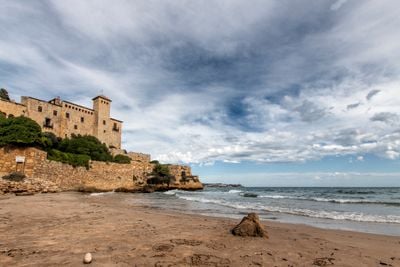
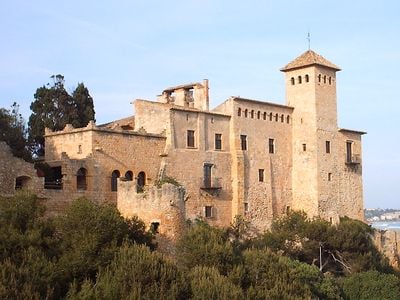
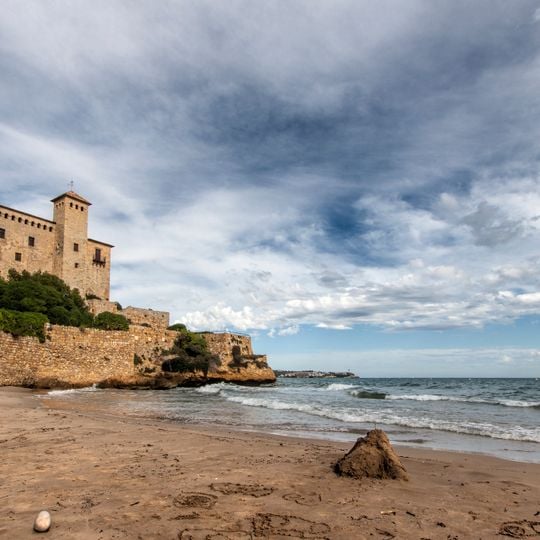
Castell de Tamarit is a Romanesque castle on a promontory between Tamarit beach and Cala Jovera, in Tarragona. Its walls enclose the walled village of Tamarit, whose houses merge with the castle itself. A square tower with a shallow tiled pyramid roof and rows of small arched openings rises beside stepped walls of tan and pale ochre stone, with a small wooden balcony projecting from one wall.
Tamarit was the southernmost castlania of the County of Barcelona in the 11th century; Bernat Sendred de Gurb sold it to Ramon Berenguer I in 1049, and on 30 March 1060 the count enfeoffed it to Bernat Amat de Claramunt with the title of Viscount of Tarragona. In 1363 Peter III ordered the walls built because of the war with Castile, and the castle defended the coast against Berber and Ottoman pirates.
The walled village of Tamarit, whose houses merge with the castle walls, keeps the Romanesque church of the Assumption of the Virgin Mary, dependent on the Archbishopric of Tarragona, and several manor houses known as "del castlà". Of the four original gates, two survive: the Mora gate and the Creu gate. The castle is private and rented for concerts and weddings.
The castle is private property used for events, with no guided tours and no public opening, so it is seen from outside. It stands on a promontory between Tamarit beach and Cala Jovera, in the municipality of Tarragona. The medieval walled village around it keeps two of its four gates, the Mora and the Creu.
During the Spanish Civil War, an FAI group came to burn the church and its baroque altarpiece, as they had done at Altafulla. They were warned that the owner was the American Charles Deering, founder of the Maricel Museum in Sitges, and the anarchist brigade gave up the plan.
The community of curious travelers
AroundUs brings together thousands of curated places, local tips, and hidden gems, enriched daily by 93,401 contributors worldwide.