Museo de Almería, Archaeological museum in central Almería, Spain.
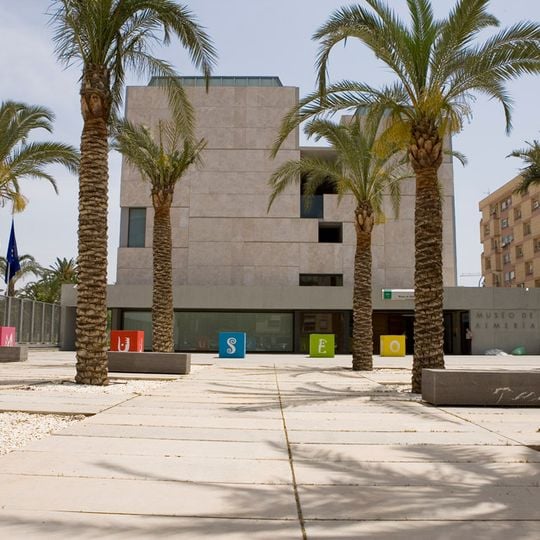
The Museo de Almería occupies a contemporary three-story building designed by Ignacio García Pedrosa and Ángela García de Paredes. A stratigraphic column rises through all three floors to the roof. The permanent exhibition on the first and second floors covers hunter-gatherer societies, Los Millares and El Argar, while the third floor displays Roman and Andalusian pieces.
The Provincial Archaeological Museum of Almería was created by decree on 28 March 1933 and opened in 1934 in two rooms lent by the Escuela de Artes y Oficios on Calle Javier Sanz. After the death of its director Juan Cuadrado Ruiz in 1952 it closed, reopening in October 1982 in the former Colegio Menor Santa María del Mar. Structural problems forced its closure in 1991, and the current building by Ignacio García Pedrosa and Ángela García de Paredes opened in 2006.
The museum displays how people lived in this region across thousands of years, from the first settlers through Roman and Islamic periods. The exhibition helps visitors understand the layers of local history through objects and reconstructions showing how life changed here over time.
The building is easily reached from the city center and the galleries are clearly marked throughout. Visitors should allow time to move through the floors, with lower levels showing the oldest finds arranged in chronological order.
On the second floor, the "Circle of Death" display uses video projection, shadows and sound to show the collective use of graves and the ritual sequence performed with each new burial. The room also holds the "Circle of Life", a metal structure surrounded by objects on trade and war of the Los Millares society.
The community of curious travelers
AroundUs brings together thousands of curated places, local tips, and hidden gems, enriched daily by 93,991 contributors worldwide.