Santa Creu d'Olorda hermitage, Romanesque hermitage in the Collserola range, Barcelona, Spain
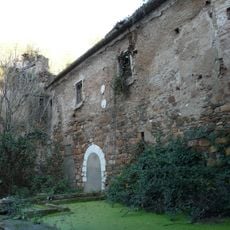
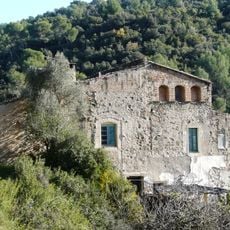
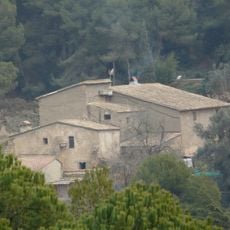
Santa Creu d'Olorda hermitage sits on a hilltop in the Collserola Natural Park, featuring a traditional stone structure with a bell tower and dense forest surroundings. The building displays simple early medieval construction with thick walls and narrow window openings.
The church of Santa Creu is first documented in 1066, and in 1147 the site was given to the monastery of Sant Cugat del Vallès. The apse retains pre-Romanesque elements from the 8th–9th centuries, followed by a Carolingian raised crossing, a bell gable of 1619 and a 16th-century Renaissance door. In 1820 it became an independent municipality, dissolved in 1915; the whole complex was burned in 1936 and restored by the Els Blaus de Sarrià hiking group.
The name Olorda is also borne by the surrounding Puig d'Olorda and the stream of Sant Bartomeu. The parish of Sant Bartomeu de la Quadra was a suffragan of Santa Creu from the 16th century. Since 2017 the parish has been administered by a priest from Molins de Rei under the bishopric of Sant Feliu.
The hermitage stands at kilometre 6.5 of the BV-1468 road between Molins de Rei and Vallvidrera, and a road to Sant Feliu de Llobregat passes by the Sanson cement works. The site is a popular recreational area for people from Molins de Rei, Sant Feliu and Sant Cugat, so weekends are busier.
The fortified building outside the walled enclosure may be the castle of Olorda, mentioned in no royal chronicle. The site's name appears in documents from 1032 and 1066, and the whole complex was burned in 1936 and restored by the Els Blaus de Sarrià hiking group.
The community of curious travelers
AroundUs brings together thousands of curated places, local tips, and hidden gems, enriched daily by 95,277 contributors worldwide.