Sant Salvador de Breda, Romanesque monastery and Gothic church in Breda, Catalonia, Spain
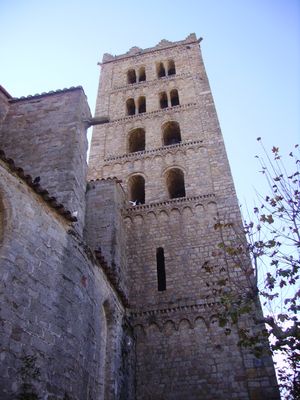
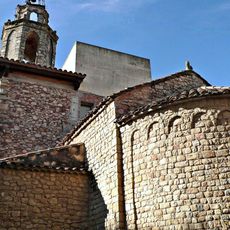
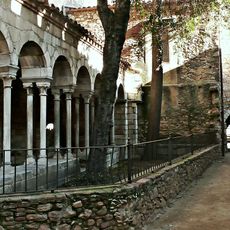
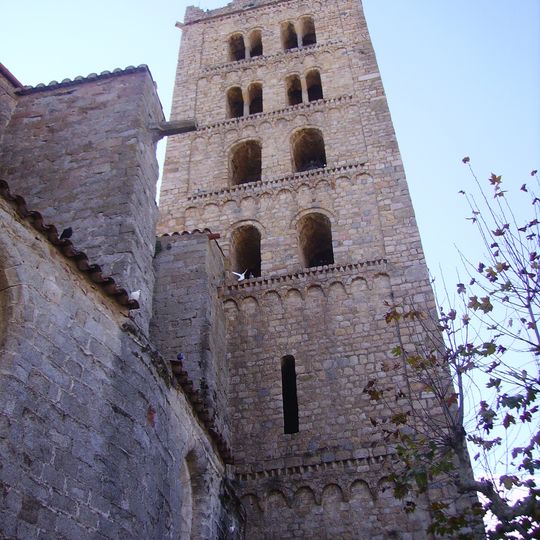
Sant Salvador de Breda is a former Benedictine monastery in the town centre, between the plaça de l'Ajuntament and the carrer dels Capellans. Of the old complex three elements remain: the Gothic church, the Romanesque bell tower and the north gallery of the cloister. The church has a single nave 33 m long and 12.5 m wide, with a pointed-arch portal and a polygonal apse. The square bell tower, 32 m high, is attached to the north side and divided into six levels by bands of blind arches and sawtooth friezes; its upper tiers have paired arched openings, and a battlemented parapet crowns it.
Construction began on 4 June 1038 under the first abbot, Sunyer, who died before completion; his successor Amat finished the work, and the bishops of Girona and Barcelona consecrated the church on 4 October 1068. The Cabrera viscounts, linked also to Montsoriu castle, funded the Benedictine house. Abbot Miquel Samsó, president of the Generalitat from 1470 to 1473, built the Gothic abbey house and church facade. The monks left definitively in 1835.
The monastery's name comes from the Catalan for Holy Saviour. Devotion centred on the relics of Saints Iscle and Victòria, given in 1263 by Viscount Guerau IV de Cabrera; the chest holding them vanished between 1820 and 1823, but two bust-shaped reliquaries survive. The former church of Santa Maria, built to receive the crowds of pilgrims, now houses the Josep Aragay municipal museum.
The monastery stands in Breda's old centre, between the plaça de l'Ajuntament and the carrer dels Capellans, so it is reached on foot. The church serves as the parish temple and the former abbey church of Santa Maria houses the municipal museum with Josep Aragay's work. The bell tower, restored in 1951, is attached to the north side of the church.
The bell tower is the best-preserved part of the monastery and was built in the 11th century, not over several centuries. It is 32 metres tall with six levels, and its paired arched windows are separated by columns with mensuliform capitals. During the Peninsular War, French troops took 17 bells from Sant Salvador; today only two remain, and the ringing was electrified in 1972.
The community of curious travelers
AroundUs brings together thousands of curated places, local tips, and hidden gems, enriched daily by 94,329 contributors worldwide.