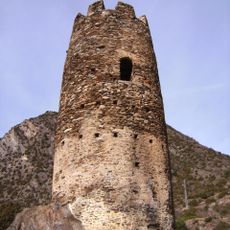
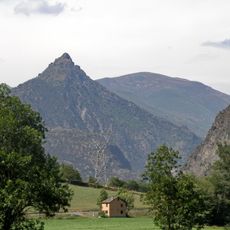
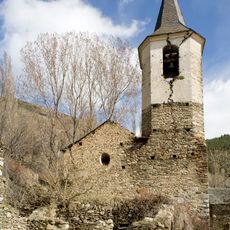
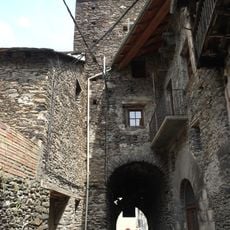
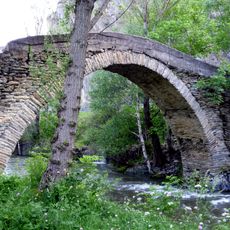
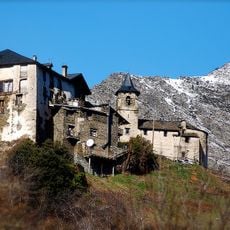
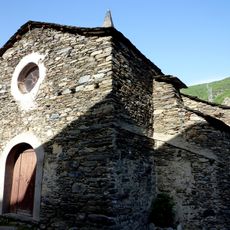
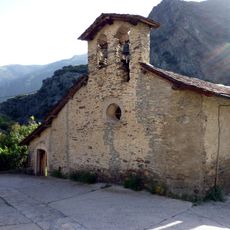
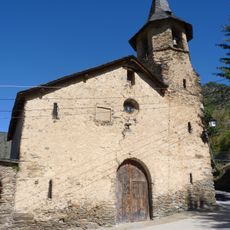
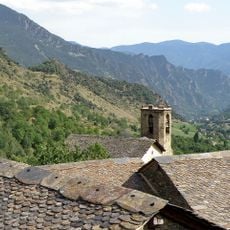
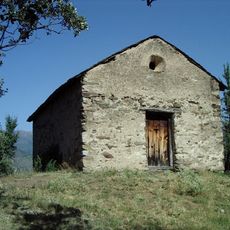
Sant Pere del Burgal, Romanesque monastery in La Guingueta d'Àneu, Spain.
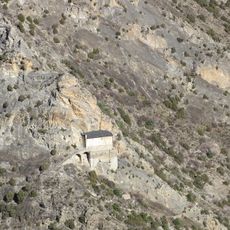
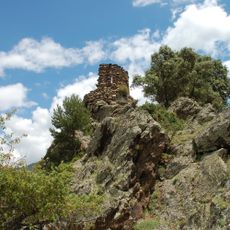
Sant Pere del Burgal is a ruined Benedictine monastery near Escaló, in La Guingueta d'Àneu. Its 11th-century church has a basilical plan with three naves, the central one taller, separated by square pillars, and a double east end: three apses at the east and one at the west, where an altar base was found. The main door opens in the west facade of the north side aisle.
The monastery first appears in written records in 859 when Abbot Deligat received immunity privileges from Count Ramon of Toulouse. This early recognition shows the importance that the site already held in the early medieval period.
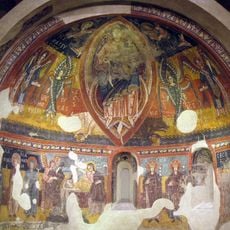
The original apse paintings, dated 1080–1090 and attributed to the Master of Pedret, are now in the Museu Nacional d'Art de Catalunya in Barcelona; reproductions stand in the church. They show the Pantocrator between the archangels Michael and Gabriel, adored by two saints, and a lady with an inscription identified as Countess Llúcia de la Marca, wife of Artau I of Pallars Sobirà, dated 1085. Such donor portraits are exceptional in Catalan Romanesque art outside the Àneu valleys.
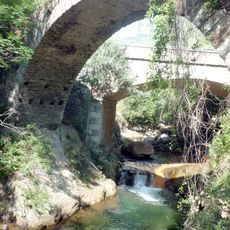
Visitors reach the monastery by crossing the Noguera Pallaresa River from Escalo and following a 500-meter path that leads up the mountain slope. The climb requires sure footing, but the walk is not especially long or technically demanding.
The monastery became the subject of ownership disputes between Santa Maria de Gerri and Santa Maria de la Grassa, leading to the creation of forged documents. These conflicts reveal how valuable and contested such foundations were during the medieval period.
The community of curious travelers
AroundUs brings together thousands of curated places, local tips, and hidden gems, enriched daily by 93,416 contributors worldwide.