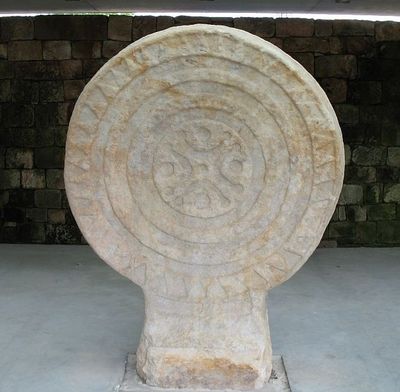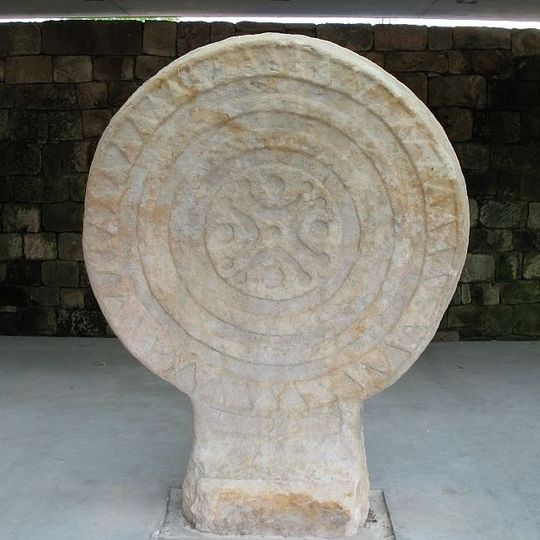
Giant stele, Archaeological site in Los Corrales de Buelna, Spain.
The Giant Stele is a flat, circular stone disk that was set upright in ancient times and displays geometric symbols carved into its surface. Today you can find it at the Parque de las Estelas in Barros, alongside other regional stone objects.
The stele dates to the 4th century BC and is thought to have marked the tomb of a warrior of the late Bronze or early Iron Age before being moved. In 1946 it was taken to the Museum of Prehistory and Archaeology of Cantabria in Santander, prompting the people of Barros to demand its return; it came back a year later. It was declared a Bien de Interés Cultural in 1985 and has stood in the Parque de las Estelas de Barros since 2001.
The carved patterns on the stone reflect how ancient Cantabrian people expressed their beliefs and knowledge through visual symbols. These designs appear on many objects found across the region, showing a shared artistic tradition.
The site is located in an open park setting that is easy to access and suitable for visitors of all ages. You can walk around freely to view the stone from different angles and explore the other artifacts on display.
The stele's concentric-circle and triangle design was adopted into the coat of arms of Cantabria, and the Cantabrian labarum flag repeats it. The disk is not the largest of its kind: a 1.90 m stele survives as the lintel of the Ermita de la Virgen de la Rueda.
The community of curious travelers
AroundUs brings together thousands of curated places, local tips, and hidden gems, enriched daily by 94,611 contributors worldwide.