Santa Maria de Barberà, Romanesque church in Barberà del Vallès, Spain
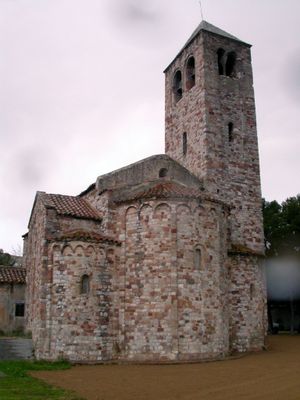
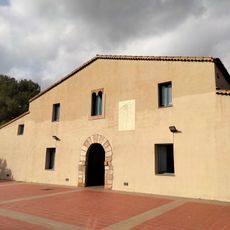
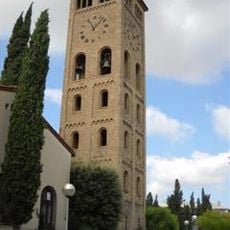
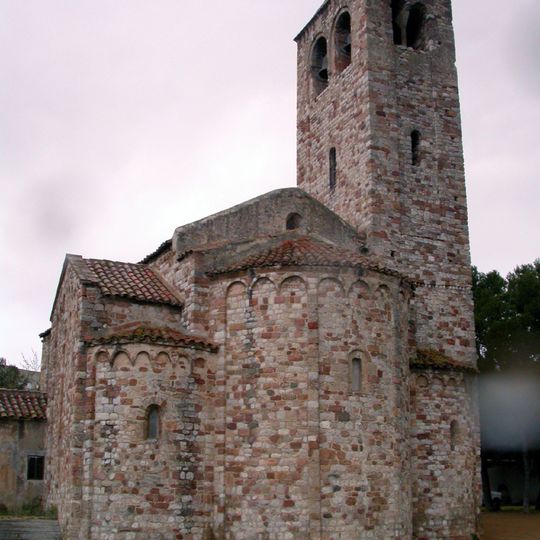
Santa Maria de Barberà is a Romanesque church with a Latin-cross plan, a single nave covered by a slightly pointed barrel vault, and three east-facing apses. Its walls are built of well-cut, two-coloured ashlar blocks, decorated only with Lombard bands and blind arcades at the head. A rectangular bell tower rises over the north transept arm, and the west door is a double arch of small voussoirs.
Documented from 986, when King Lothair confirmed possessions at Barberanus to Sant Cugat, the church was built in the second half of the 11th century, with bequests for the works recorded in 1067 and 1074. It was consecrated under Bishop Oleguer of Barcelona (1116-1137) and appears as a parish in 1143. In 1919 Mossèn Manuel Trens and rector Josep Maria Esteve uncovered the apse paintings behind a retable; after the Civil War, paintings and church were restored with the Diputació de Barcelona's monument service.
The interior preserves medieval wall paintings depicting biblical scenes that reflect how people of that era understood and visualized their faith. These artworks from different periods show how worship practices and artistic expression changed over time in this space.
The church is open to visitors on most days, and guided tours are available to explain the building's architectural features and design elements. As an active place of worship, visitors should dress respectfully and be mindful of any ongoing religious services or events.
The 1919 discovery was made by Mossèn Manuel Trens, director of the Diocesan Museum of Barcelona, and the rector Mossèn Josep Maria Esteve, who uncovered the paintings behind a retable covering the central apse. The murals, dated to the late 12th century and attributed to the Master of Cardona, remain in situ.
The community of curious travelers
AroundUs brings together thousands of curated places, local tips, and hidden gems, enriched daily by 94,390 contributors worldwide.