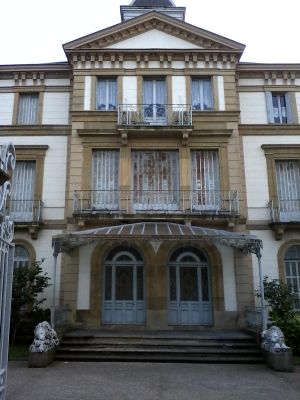
Villa Munda, Historical residence in Zarautz, Spain.
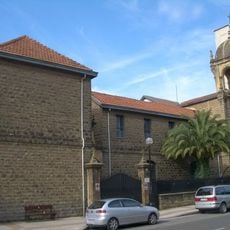
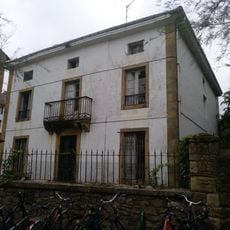
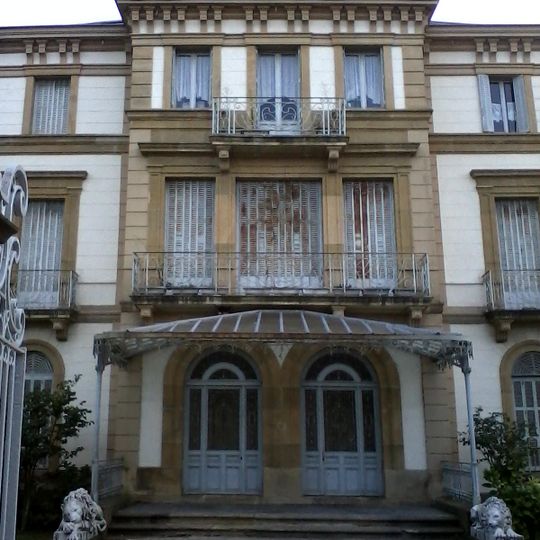
Villa Munda is an eclectic-style summer palace on Calle de Navarra in Zarautz, set back from the sea. It has three floors plus a tower and a square original plan; later two lower bodies were added to the south facade, forming a U-shaped patio. The building is surrounded by the public garden Zuhaizti, also called El Parque de los patos.
Villa Munda was built in the last third of the 19th century on the site of Zarautz's former municipal cemetery, commissioned by the Segovian physician Pedro González de Velasco, founder of the National Museum of Anthropology. He paid 14,500 reales for the construction plus the costs of exhuming and moving the bodies. After his death in 1882, the property passed to José de Murga y Reolid, first Marquis of Linares, and later to his goddaughter Raimunda Avecilla y Aguado, Countess of Villapadierna, whose family kept it until the mid-20th century.
The building is named after Raimunda de Osorio y Ortega, wife of José de Murga y Reolid, first Marquis of Linares, who bought it after the death of its builder in 1882. In its garden stands a monument to the Zarautz-born composer Francisco Escudero. Today the villa houses the town's Municipal Music Conservatory and Academy.
The building sits near the center of Zarautz and is accessible by local transportation options. Since it hosts regular events, it is worth checking the schedule ahead of a visit.
The villa's name comes from Raimunda de Osorio y Ortega, wife of José de Murga y Reolid, 1st Marquis of Linares, who bought the property after the death of its builder, the Segovian doctor Pedro González de Velasco, in 1882. A Basque legend holds that the owner embalmed his deceased daughter and took her out walking.
The community of curious travelers
AroundUs brings together thousands of curated places, local tips, and hidden gems, enriched daily by 93,971 contributors worldwide.