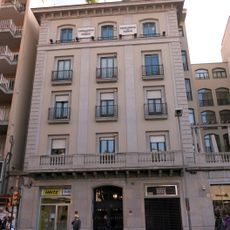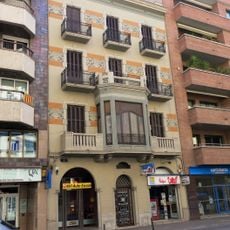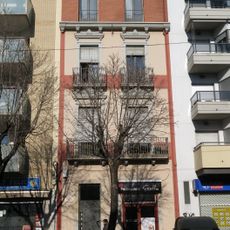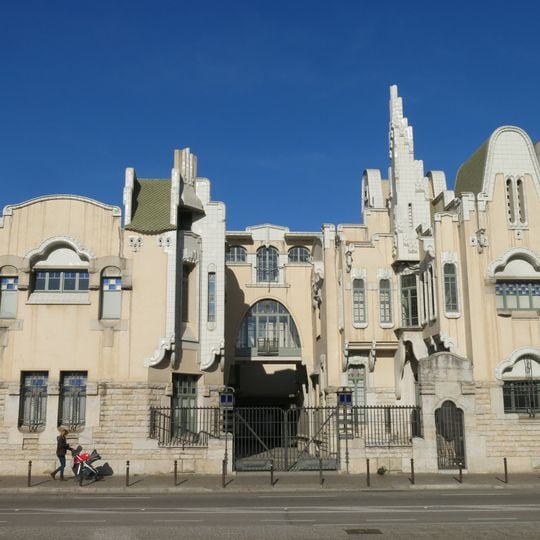
Farinera Teixidor, Art Nouveau flour mill in Girona, Spain
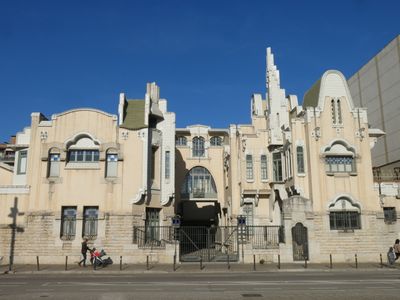
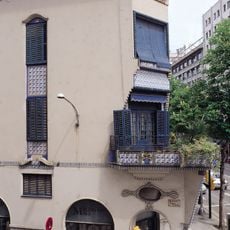
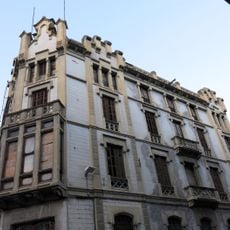
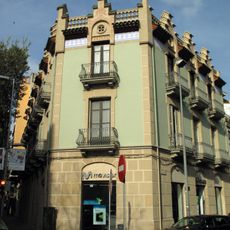
Farinera Teixidor is a flour mill complex on Carrer de Santa Eugènia in Girona, built from 1910. Its two main blocks, the Teixidor family home on the right and offices on the left, are linked at the first floor by a walkway on parabolic arches. Stone bases, white glazed ceramic and green glazed tiles on the roof evoke sacks of flour.
Rafael Masó i Valentí designed the mill complex between 1910 and 1911 as a modern industrial facility. Additional storage buildings were added in 1923 to support the growing milling operations.
Masó designed the pinnacles as wheat ears and the ironwork as wheat spikes, so the mill's function is legible from outside. The white majolica came from Antoni Serra's workshop, the green scales from the Coromina brothers, the forge from Nonici Cadenas and the stained glass from Rigalt, Granell & Cia.
The complex stands at Carrer de Santa Eugènia 42, between the Santa Eugènia road and the Monar irrigation channel, a short walk from the train stations. The ceramic pinnacles, white tile bands and forged wheat-ear grilles are best seen from the street; the passage under the parabolic arch leads into the interior of the block. The building housed the newspaper El Punt until 6 June 2015.
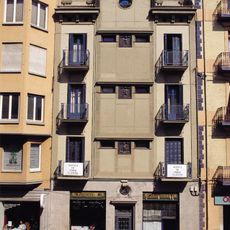
The wrought-iron grilles on the windows and doors, made by the Girona locksmith Nonici Cadenas to Masó's designs, carry wheat-ear motifs between the bars. The same ear shape crowns the main pinnacle, so the building's function as a flour mill is spelled out in its metalwork and ceramics.
The community of curious travelers
AroundUs brings together thousands of curated places, local tips, and hidden gems, enriched daily by 93,855 contributors worldwide.