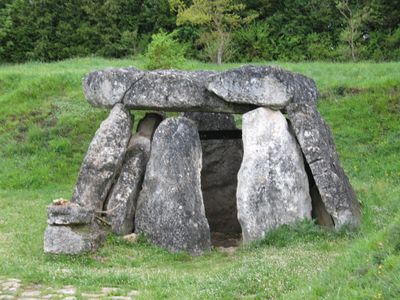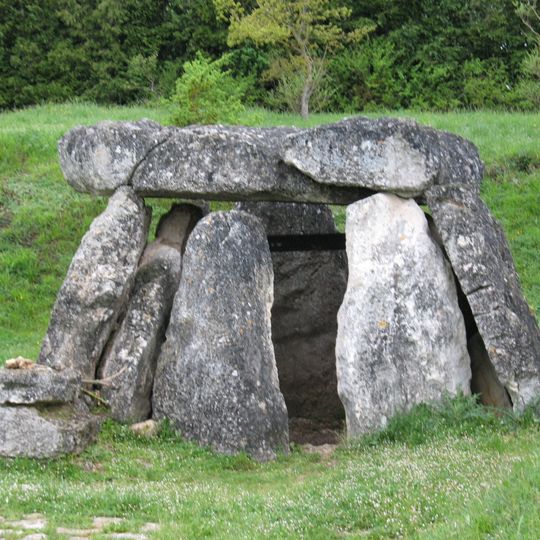
Aizkomendi, Megalithic dolmen in Eguílaz, Álava, Spain.
Aizkomendi is a dolmen in Eguílaz, Álava, made of six slabs forming a chamber about 3 m long, 1 m wide and 3 m high. It sits within a large tumulus, of which part remains, with a circular stone feature and a gap where the corridor once was.
Aizkomendi was discovered in 1832, and its material was largely emptied out soon after. E. Eguren carried out another excavation in 1925, and José Miguel de Barandiaran dug the site in 1965, fearing the impact of the planned N-1 road; this is considered the first case of preventive archaeology in the Basque Country. Burials in the chamber and corridor date to the Chalcolithic and Bronze Age, and cremations were later placed in the mound during the Iron Age.
The dolmen has no specific Basque legend attached, which is unusual in the region. Instead, it appears in a romantic tale by the Álava writer Ricardo Becerro de Bengoa, set during a bloody conflict between "Basque-Iberians" and Celtic invaders who merged to form the Celtiberian people and built the dolmen for their dead.
The dolmen stands beside the old livestock route that ran between the Entzia and Aizkorri ranges, in the Egílaz district of Donemiliaga. The mound is partly preserved, with a circle of stones still visible and a gap where the corridor once opened to the east. The site is reached on foot from the surrounding fields.
The 1965 excavation by José Miguel de Barandiaran was carried out to assess the impact of the planned N-1 road on the monument, making it an early case of preventive archaeology in the Basque Country. The mound also holds a stone circle and a gap where the corridor once stood.
The community of curious travelers
AroundUs brings together thousands of curated places, local tips, and hidden gems, enriched daily by 94,070 contributors worldwide.