Virxe da Barca sanctuary, Baroque shrine to Virgin Mary in Muxía, Spain.
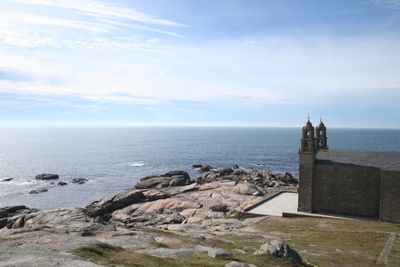
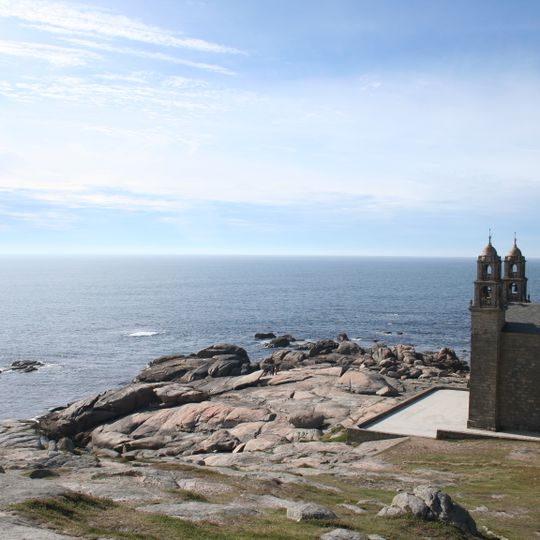
The Virxe da Barca sanctuary is a church built between 1716 and 1719 on a rocky point facing the Atlantic in Muxía. Its facade of rough dark grey-brown stone rises to a flat roofline topped by two matching towers with arched openings and rounded cupolas bearing small crosses. A paved area adjoins the base.
A 12th-century hermitage is the first documented construction on the site, with written evidence from 1544. From the 17th century, miracles attributed to the Virgin drew ever larger buildings, and the present church was built between 1716 and 1719 under the patronage of the Dukes of Maceda, whose remains were later placed inside. In the 19th century the casa rectoral (1828) and a espadaña (1834) were added, and a Galician emigrant to America financed the two towers that crown the facade in the 20th century.
Local legend tells that the apostle James, discouraged while preaching in Hispania, was consoled here by the Virgin Mary, who arrived on a stone boat and told him to return to Jerusalem. The boat's remains are said to be the rocks in front of the church. Some pilgrims walk on from Santiago de Compostela to this sanctuary, extending the Camino to the Atlantic coast.
The church stands at the end of the harbour front in Muxía, on a paved platform beside the rocks; the coastal path to it is flat and short. The open Atlantic side is exposed to wind and rain, so bring a waterproof layer. The sanctuary is also the final stage of the extended Camino de Santiago to the coast.
Next to the church, three natural rocks on the shoreline are considered sacred: the Pedra de Abalar, the Pedra dos Cadrís, and the Pedra do Timón. According to local tradition, they are said to be the remains of the boat that brought the Virgin Mary to this spot.
The community of curious travelers
AroundUs brings together thousands of curated places, local tips, and hidden gems, enriched daily by 93,509 contributors worldwide.