Castillo de las Escobetas, Military fortress in Garrucha, Spain.
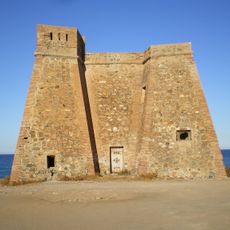
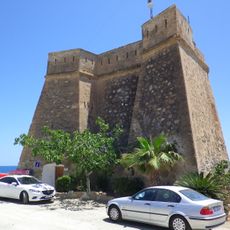
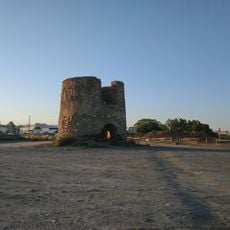
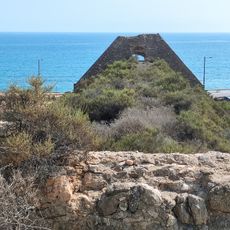
Castillo de las Escobetas, also called castillo del Nazareno, is a masonry fort of three bodies. The central body is rectangular with rounded short sides pierced by a rectangular door; a truncated-pyramid body with sloping walls and a parapet with loopholes adjoins its right side, and a lower body without openings adjoins the left. An external single-flight staircase against the right side gives access.
Construction of the fortress began in 1769 under architect Francisco Ruiz Garrido as a defense against pirate raids along the Mediterranean coast. It was part of a broader program of coastal fortifications that Spain built to protect its shoreline during that period.
The castle is also called Castillo del Nazareno, after Jesús Nazareno. Its construction was entrusted to Rafael de Mora y Saavedra, who received two cavalry companies, one for himself and one for his son. In 1963 the Ministry of Culture declared it a Bien de Interés Cultural monument.
Access to the upper level is by a single-flight external staircase attached to the right side of the structure. The left-hand body is lower, with no openings or loopholes, so the entrance and the parapet with its loopholes are both on the right. The site stands in Garrucha, about 5.23 km north of Cantal Point.
The castle was built in masonry in three sections: a rectangular central body with rounded short sides, a truncated-pyramid block with sloping walls and loopholes on the right, and a lower, windowless body on the left. The external staircase has a single flight and is attached to the right side, not the left.
The community of curious travelers
AroundUs brings together thousands of curated places, local tips, and hidden gems, enriched daily by 94,224 contributors worldwide.