Los Ribera Castle, Renaissance palace and castle in Bornos, Spain.
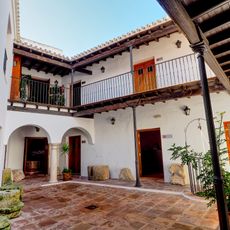
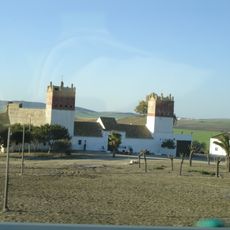
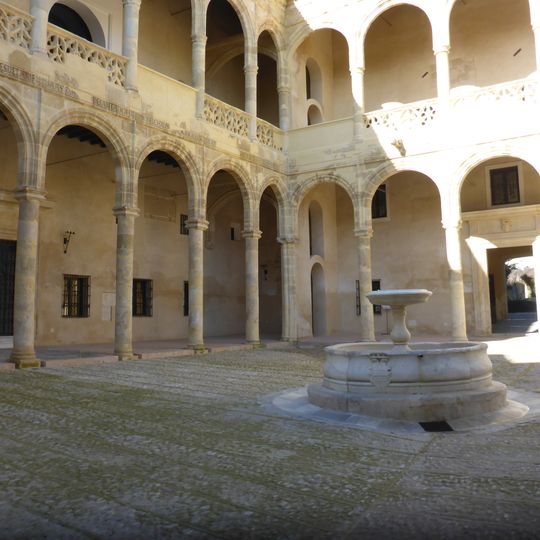
The Palacio de los Enríquez de Ribera stands in Bornos on the site of the Arab Castle of Fontanar, of which only stretches of wall and the square Torre del Homenaje survive, at the palace's southwest corner. Around a courtyard porticoed on two sides run two storeys of raised semicircular arches with a Gothic balustrade, gargoyles above the lower arcade and a late-Gothic doorway with cardoon-leaf carving in the upper gallery. The tower windows show pages holding a ducal crown.
The castle of Fontanar, of Arab origin, was bought in 1398 by Per Afán de Ribera el Viejo, adelantado mayor of Andalusia; Enrique II had granted the town and fortress to the lords of the House of Marchena around 1387. In the 16th century the Enríquez de Ribera family turned it into a Plateresque palace, with Fadrique Enríquez de Ribera, first Marquis of Tarifa, hiring Spanish and Italian artists. Per Afán (III) de Ribera, first Duke of Alcalá de los Gazules, had Benvenuto Tortello adapt the old fortress and build the gardens between 1569 and 1571, though the work was left unfinished.
The palace takes its name from the Enríquez de Ribera lineage, who bought the Fontanar castle in 1398 through Per Afán de Ribera el Viejo, adelantado mayor of Andalusia. Per Afán (III) de Ribera y Portocarrero, first Duke of Alcalá de los Gazules and viceroy of Catalonia and Naples, brought marbles from Italy and commissioned Benvenuto Tortello of Brescia to adapt the fortress and lay out plateresque gardens. The loggia, restored in 2015, served to display his collection of classical mythological sculptures, most of which are now in the Casa de Pilatos in Seville.
The palace stands in Bornos, in the province of Cádiz, built into the remains of the Castillo del Fontanar; the Torre del Homenaje and stretches of the old wall survive at its southwest corner. The first floor holds an interpretation centre. The building was restored between October 1992 and September 1995 by an Escuela Taller, whose students worked on the forge, painting, carpentry, gardening, stonework and masonry, including the Renaissance and Arab garden.
The upper gallery of paired supports was modelled on Bramante's Belvedere Courtyard in the Vatican, though it has since disappeared. The palace's cresting of fleur-de-lis was largely dismantled and moved to the Casa de Pilatos in Seville by the Dukes of Medinaceli, who then owned the building.
The community of curious travelers
AroundUs brings together thousands of curated places, local tips, and hidden gems, enriched daily by 94,841 contributors worldwide.