Església de Sant Vicenç de Sarrià, Neoclassical church in Sarrià, Spain.
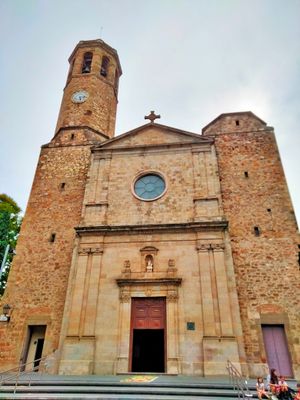
The Església de Sant Vicenç de Sarrià is a Neoclassical church with three naves and five sections, its central nave covered by barrel vaults on square Corinthian pillars. The flat-ended presbytery holds a sculpted tabernacle by Lluís Bonet i Garí and frescoes of the life of Saint Vincent by Josep Obiols.
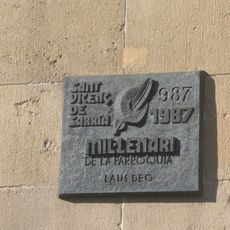
A chapel is documented in 987; a Romanesque church was consecrated in 1147 by Bishop Guillem de Torroja, and a Gothic church consecrated in 1379 held a retable painted by Jaume Huguet, now in the MNAC. Josep Mas i Dordal designed the present church in 1779; a royal works decree of 1781 allowed building from 1781 to 1816, blessed in 1789. Fire in 1936 destroyed the interior, and Lluís Bonet i Garí restored it in 1940.
The parish lies on the Camí de Mar route of the Camino de Santiago, marked by a scallop shell inside a laurel wreath carved on the main portal's entablature. Inside, the Rosary altarpiece carved by Agustí Pujol between 1617 and 1619 stands in the transept; damaged in the Civil War, it was reworked in 1914.
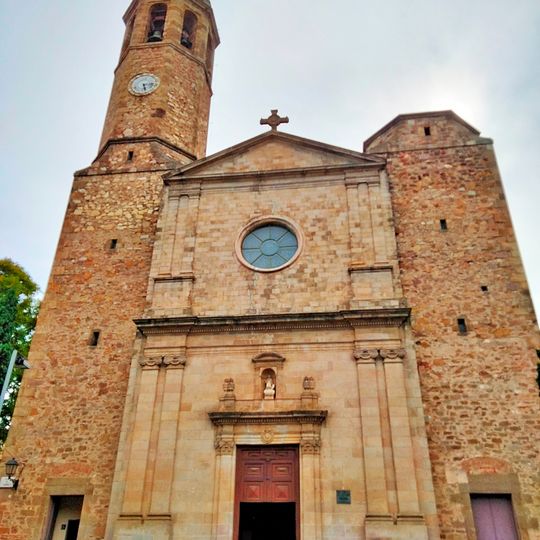
The main entrance opens onto Plaça de Sarrià, at the corner of Carrer Major de Sarrià and Passeig de la Reina Elisenda de Montcada; the transept and presbytery share walls with neighbouring buildings, so the church is entered from the square. The two planned octagonal bell towers were never both built: only the southern one stands, while the northern one was left as a stub. The interior is reached through a narthex under the choir, in the manner of Ignatian churches.
Only the southern of the two planned octagonal bell towers was built; the northern one was left as a stub. The 1936 fire destroyed the interior, and the church's two bells were melted down to make cannons. The Neoclassical facade's central body is dressed in sculpted Montjuïc stone.
The community of curious travelers
AroundUs brings together thousands of curated places, local tips, and hidden gems, enriched daily by 94,655 contributors worldwide.