Castell de Savassona, Medieval castle in Tavèrnoles, Spain
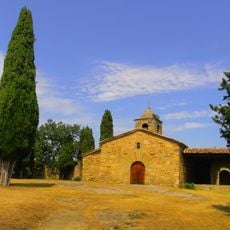
Castell de Savassona stands on a hill at 611 metres in Tavèrnoles. The present building is a large rectangular house of three sections with two-slope Arab-tile roofs, built by the Vila family in the 16th and 17th centuries and renovated in 1775 and after 1814. Its south facade has a stone portal, a first-floor balcony and, on the second floor, the carved arms of the Ferrer-Llupià and a marble bust of Antoni de Ferrer-Llupià. The medieval part is a triangular structure of about 12 m² with 1.10 m thick walls and a triangular vault, next to a round tower and the Romanesque chapel of Sant Pere, documented in 1060.
The castle is first mentioned in 921, while the Savassona estate appears in a document from 889. Around 1082 the counts of Barcelona linked it to the viscounts of Osona-Cardona, and in 1280 it passed from the Savassona family to Ramon de Vilanova. In 1811 Napoleonic troops set it on fire; it was restored after 1814.
The name Savassona comes from the knightly family that governed the castle from the 11th century. The chapel of Sant Pere, at the foot of the castle, is a Romanesque church from 1060. The Ferrer-Llupià family, who made Savassona their summer residence, left their coat of arms and a marble bust of Antoni de Ferrer-Llupià on the main façade.
The castle sits on a hilltop and offers views across the surrounding region, though reaching it requires some physical effort. Visitors should expect uneven terrain and narrow passages in places, as this is a historic site with original structures.
The castle once passed through the hands of several noble families, moving from the Vila family to the Llupia family and finally to the Ferrer family. In 1900 it was sold to Vicenç Cuyàs Piera, marking a new chapter for the property.
The community of curious travelers
AroundUs brings together thousands of curated places, local tips, and hidden gems, enriched daily by 94,645 contributors worldwide.