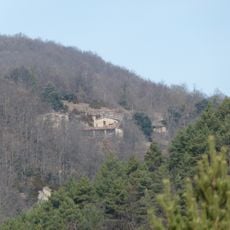
Via romana del Capsacosta, Roman road between La Vall de Bianya and Sant Pau de Segúries, Spain
The Via romana del Capsacosta is a Roman mountain road between La Vall de Bianya and Sant Pau de Segúries featuring preserved stone walls, wagon grooves, and ancient construction elements. The path displays different building techniques and engineering solutions across its sections.
The road was a secondary Roman route connecting settlements and enabling trade and troop movements through the Pyrenean landscape. It was designed to meet the practical demands of mountain travel.
The name Capsacosta comes from the Latin caput costae, "head of the slope", referring to the hill the road crosses. The route was used continuously until 1926-1927, when the C-153 road was built, after which it served only for livestock herding. Two drainage channels still pass beneath the roadway and exit at the base of the retaining walls.
The best-preserved section lies between Hostalets de Sant Salvador and the junction with the old Capsacosta road. Wear sturdy footwear and prepare for uneven terrain.
The sources name only two other Catalan roads with comparable features: the Parpers hill road between Caldes de Montbui and the coast road to Mataró, and the link between the Via Augusta and the Camí d'Empúries near Gaüses, Rupià and Corçà. The quarries that supplied the stone have never been located.
The community of curious travelers
AroundUs brings together thousands of curated places, local tips, and hidden gems, enriched daily by 94,919 contributors worldwide.