Cala Pi, White sand beach and cove in Llucmajor, Spain
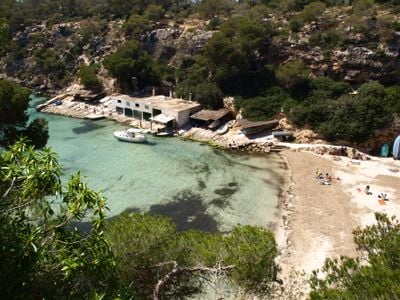
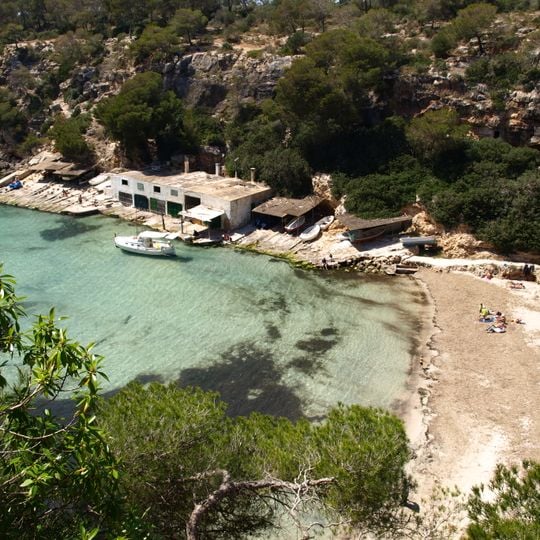
Cala Pi is a 420-metre-long, up to 100-metre-wide rocky inlet on the Llucmajor coast, the mouth of the Torrent de Cala Pi. At its head lies a fine-sand beach about 50 metres wide that runs some 125 metres into the gorge, whose rocky slopes are planted with pines. On the west side stand several escars, boat shelters built in 1954 of marès stone with flat roofs and wooden doors, facing a concrete slipway.
The Torre de Cala Pi, built in 1663 on the Punta de Cala Pi, guarded the bay entrance against North African corsairs. Prehistoric remains show earlier use: the Cova de Cala Pi served as a burial site, and talayotic structures stand on the western side. The six stone escars were added in 1954.
The name Cala Pi most likely comes from a medieval Llucmajor surname, Pi, rather than from a pine tree, as no document records a pine here; the nearby Cala Beltran follows the same pattern. The six stone escars on the west side were built in 1954 with marès walls, flat marès roofs on wooden beams and a chimney each; five have double wooden doors, one a metal barrier.
Reaching the beach requires descending a long staircase, so wear comfortable shoes and allow time for the walk down. Basic amenities like showers and restrooms are available, with a seasonal kiosk operating during warmer months.
The stream, the Torrent de Cala Pi, only carries water after heavy rain, and a brackish pool can then linger in the gorge behind the beach. In this pool, grey mullet (llisses) have been recorded. The bay is one of the few natural shelters on the coast between Cap Enderrocat and S'Estanyol de Migjorn.
The community of curious travelers
AroundUs brings together thousands of curated places, local tips, and hidden gems, enriched daily by 93,725 contributors worldwide.