Neu-Toggenburg castle ruin, Castle ruin in Oberhelfenschwil, Switzerland.
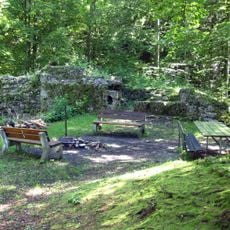
Neu-Toggenburg castle ruin preserves traces of a ring wall with an older gate, the foundation walls of a palas, and remains of two cisterns. Two inner ditches and three outer ditches are still visible. The complex dates from the late 12th century and was enlarged after 1226 with a two-metre-thick ring wall.
Neu-Toggenburg was probably built in the late 12th century, initially as a masonry residential tower. It gained importance after 1226, when Count Friedrich I of Toggenburg was murdered and the family had to abandon Alt-Toggenburg in Kirchberg; the castle was then enlarged with a two-metre-thick ring wall and a palas. After the death of the last count, Friedrich VII, it was abandoned in 1436 and passed to the Barons of Raron. In 1468 Abbot Ulrich Rösch bought it for the Abbey of St. Gallen, which let it fall into ruin.
The name distinguishes it from Alt-Toggenburg, the family's former stronghold that was eventually abandoned. Artifacts recovered from excavations offer insight into how medieval people lived and worked in this remote Alpine region.
The site is accessible by several hiking trails, with the shortest route forming a loop of about 2 kilometers suitable for most visitors. Sturdy footwear is recommended because the ground is rocky and uneven in places.
Despite having walls about 2 meters thick, the castle's remote hilltop location offered little strategic value, so it rarely appears in historical records. This isolation meant the fortress had less political importance than other noble seats of its era.
The community of curious travelers
AroundUs brings together thousands of curated places, local tips, and hidden gems, enriched daily by 93,562 contributors worldwide.