Qiandao Lake, Artificial lake and archaeological site in Jiande, China
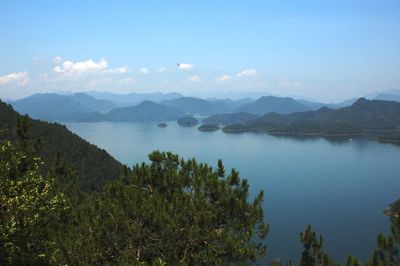
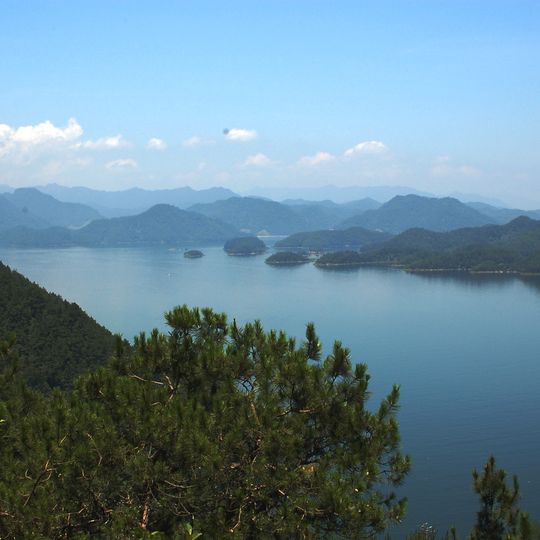
Qiandao Lake is a reservoir in Chun'an County, Hangzhou, Zhejiang, formed in 1959 when the Xin'an River was dammed. At a water level of 108 metres it holds 1,078 islands larger than 2,500 square metres, and over 90% of the surrounding land is forested. The lake covers 573 km² and stores 17.8 km³ of water.
A hydroelectric dam on the Xin'an River flooded the ancient city of Shicheng in 1959, which had been founded during the Eastern Han Dynasty between the 1st and 3rd centuries. The submerged city walls and streets remained preserved underwater and were rediscovered by divers only decades later.
The lake's name comes from the 1,078 islands that emerged when hilltops were flooded in 1959. Since 2001, the biennial Qiandao Lake Water Festival celebrates the reservoir, and local poetry includes Li Bai's "Qingxi." The submerged Shicheng, or Lion City, was the seat of Sui'an County, and its walls and streets lie intact under 26–40 m of water.
The lake lies in Chun'an County and Jiande, Hangzhou, Zhejiang. The water temperature in the top 10 metres averages between 24.4 and 28.2 °C, with a thermocline at about 30 metres depth. An expressway links Hangzhou, Qiandao Lake and Huangshan; buses leave West Hangzhou bus station every half hour, and high-speed trains serve Qiandaohu station since 25 December 2018.
The submerged Lion City sits at depths between 26 and 40 meters (85 to 131 feet) and features five city gates, while most traditional Chinese old cities had only four. Several hundred stone arches and house portals have remained nearly undamaged beneath the lakebed.
The community of curious travelers
AroundUs brings together thousands of curated places, local tips, and hidden gems, enriched daily by 93,864 contributors worldwide.