Tomb and Temple of Bi Gan, Tomb and temple complex in Weihui, Henan, China
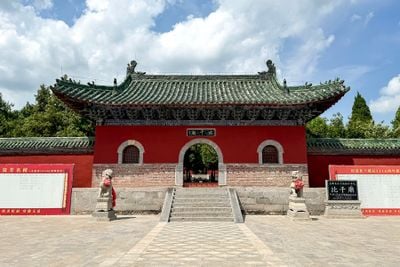
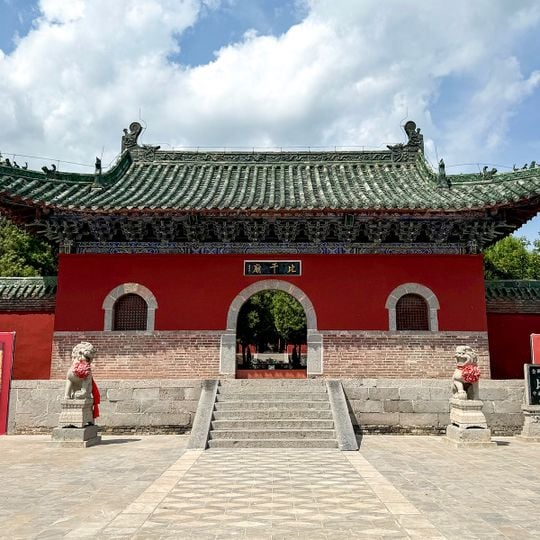
The Tomb and Temple of Bi Gan is a walled complex in Weihui, Henan, with the temple in front and the tomb behind, aligned on a north–south axis. Its gatehouse has a red facade over a brick and stone base, a wide central arch flanked by two smaller arched openings with dark lattice screens, and a green glazed-tile roof. A plaque above the central arch reads 北干廟 in gold characters, and carved stone lions sit at the foot of the central steps.
The tomb mound was reportedly enfeoffed by King Wu of Zhou. The temple was built in the 18th year of the Northern Wei Taihe era (494), and Tang Taizong, Song Renzong and Yuan Renzong all ordered large-scale repairs. The present buildings were rebuilt during the Ming and Qing dynasties.
Bi Gan is honoured as a Shang royal kinsman and the state deity enfeoffed by King Wu of Zhou, and the temple keeps both his tomb and his cult on one site. The name on the gate plaque, 北干廟, is read right to left. The tomb mound, 50 m across and 6 m high, is ringed by old cypresses.
The complex runs south to north along one axis: screen wall, mountain gate, second and third gates, the Xiangdian hall, the Sun-and-Moon archway, then the tomb mound. The gatehouse in the photograph, with its central arch and two screened side openings, is the entrance you pass through. Allow time to walk the whole axis, and note that the mound is ringed by old cypresses.
The stele said to have been cut by Confucius himself, inscribed "Yin Bi Gan Mo" (with 莫 standing in for 墓, "tomb"), is held to be the only surviving example of his handwriting and is called the "Number One Stele in the World". The temple is also the first in China to combine a tomb and a shrine, and Bi Gan's mound is the earliest recorded tumulus-style grave.
The community of curious travelers
AroundUs brings together thousands of curated places, local tips, and hidden gems, enriched daily by 94,973 contributors worldwide.