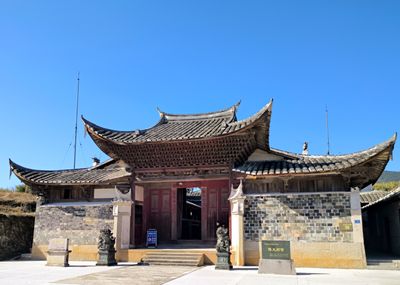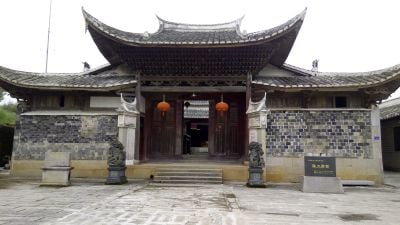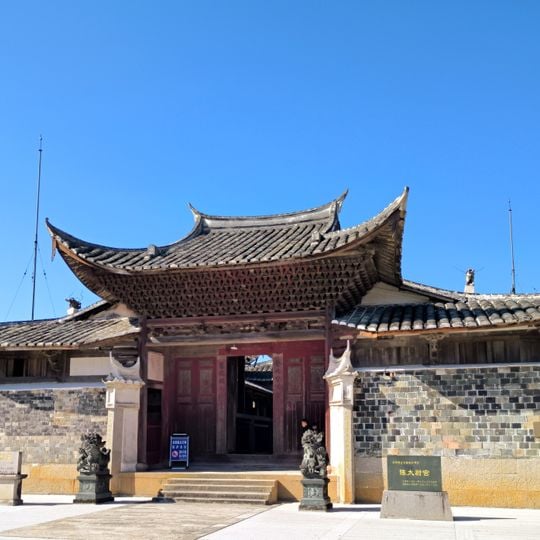
Chen Taiwei Palace, Ancient ceremonial complex in Luoyuan County, China.
Chen Taiwei Palace is an ancient ceremonial complex containing a main hall, side pavilions, and a theater stage arranged across the site. The entire compound demonstrates building techniques from the Song, Ming, and Qing dynasties.
Chen Su, a native of Gushi in Henan, settled at Caofeng in Luoyuan after entering Fujian with Wang Shenzhi in 876. In 909 he built a Chen ancestral hall, renamed Gaoxing Xiansheng Ci after his death. In 1239 the court granted him the title Xianyou Jiaying Hou and raised a palace before the hall; his fifteenth-generation descendant Chen Qing, killed fighting Mongol troops that year, was honoured as Taiwei and worshipped there, giving the shrine its name.
The temple began as the Chen family ancestral hall; locals called Chen Su "Gaoxing Xiansheng" (Mr of High Conduct) for teaching farming and rites, and the hall took that name. In 1239 the court honoured his descendant Chen Qing, killed fighting Mongol troops, as "Dutong Fumo Taiwei", and the shrine was renamed after him. The name visitors read on the green plaque, 陈太尉宫, comes from that title.
The complex welcomes visitors interested in exploring traditional Chinese architecture and comparing building styles across different dynasties. Plan time to view both the main hall and the smaller pavilions throughout the site.
The main hall's 36 columns are water-pine (shuisong) logs 4.67 m tall, and the bracket sets above them stack higher than the columns themselves, closing into a square coffered ceiling. The whole structure is said to be assembled without a single nail.
The community of curious travelers
AroundUs brings together thousands of curated places, local tips, and hidden gems, enriched daily by 95,014 contributors worldwide.