St. Maximin's Abbey, Former Benedictine abbey in Trier, Germany
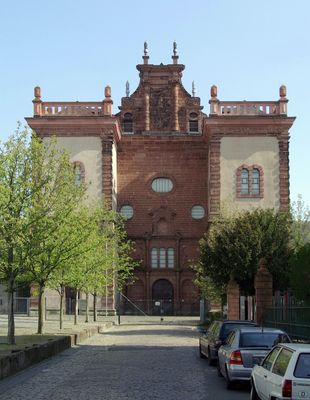
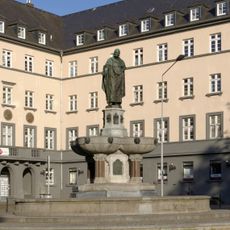
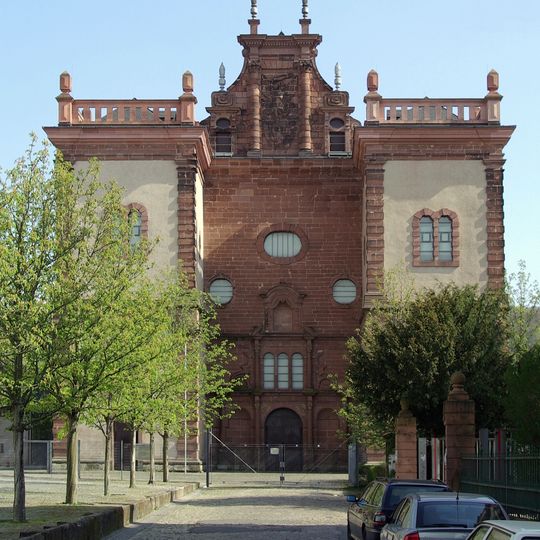
St. Maximin is a former Benedictine abbey in Trier. Its 17th-century church, rebuilt in Gothic form, has a reddish-brown and pale plaster facade with a curved gable, a dark relief panel, and a round-arched portal reached by steps. The church now serves as a school sports hall and concert venue, and a Roman cemetery with over 1,000 sarcophagi lies beneath it.
The monastery was founded in the 4th century and later suffered severe destruction from raids and warfare. After these disasters, it was repeatedly rebuilt and remained an important center of religious life through the centuries.
The abbey's name comes from Bishop Maximin of Trier, whose remains were brought to the site in 353; the church was first dedicated to Saint John the Evangelist before being renamed after him. Groups can visit the ancient cemetery beneath the church, where more than 1,000 sarcophagi have been found.
The church is now used as a concert hall and visitors should contact in advance to explore the burial chamber. Access to the underground areas is not always available, so a phone call before visiting is worthwhile.
The church that opened as a concert hall in 1995 is known for its acoustics. The abbey's former Luxembourg refuge, the Refugium St. Maximin, now houses the Luxembourg prime minister's office; the abbey's advocate Siegfried I acquired from it in 963 the Roman watchtower he rebuilt as Lucilinburhuc Castle, the origin of Luxembourg City.
The community of curious travelers
AroundUs brings together thousands of curated places, local tips, and hidden gems, enriched daily by 93,458 contributors worldwide.