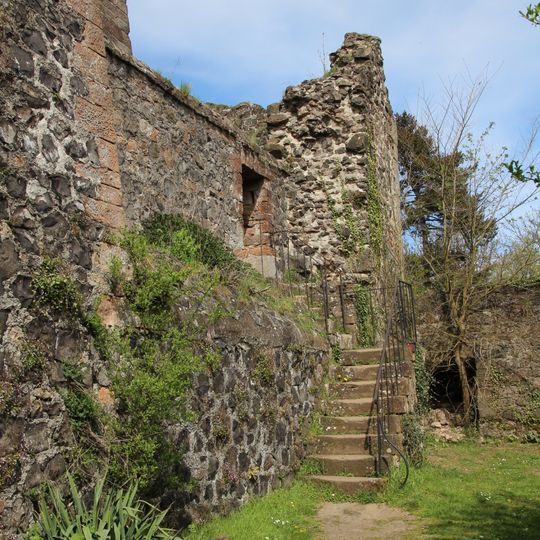
Staufenberg Castle, Castle ruin in Staufenberg, Germany
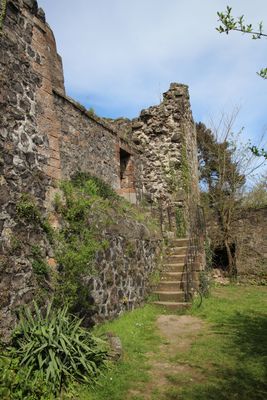
Staufenberg Castle is a hilltop ruin on the 268-metre Staufenberg in Hesse, built of rough dark grey and brown rubble masonry with some red brickwork. A tall wall section with a rectangular window opening stands on the left, and a narrower, jagged wall partly covered in climbing plants rises to its right. A stone staircase of about eight steps with a thin dark metal railing ascends beside the walls, and weeds and grass grow along the base and ledges.
The counts of Ziegenhain, advocates of Fulda Abbey, built the castle in the 12th century; it was first documented in 1233 as Stouphenberch. It was destroyed in 1273 during a war between Hesse and Mainz, then rebuilt and strengthened after 1450 under Landgrave Ludwig I of Hesse. The Thirty Years' War left it ruined, and it later served as a quarry.
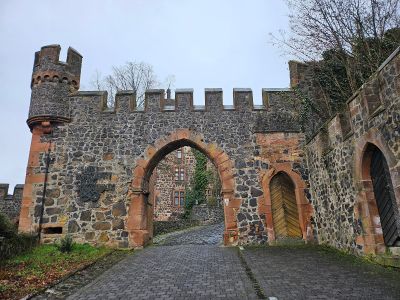
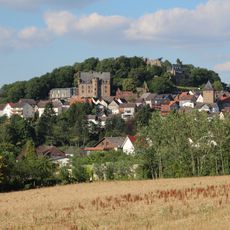
The name Staufenberg goes back to the medieval form Stouphenberch, recorded in 1233 and meaning "rock mountain", after the 268-metre hill of the Vorderer Vogelsberg. The lower castle, rebuilt in palace style after 1858, now houses the Hotel Burg Staufenberg, while the upper castle belongs to the town.
The site is easily accessible on foot via marked pathways, with the lower castle section being readily navigable as a functioning hotel and restaurant space. The upper ruins require sturdy footwear and appropriate clothing depending on weather conditions and season.
The upper castle, with part of its palas still standing, has belonged to the town of Staufenberg since 2002. From the roughly 13-metre corner tower, reached via the surviving stair turret inside the walls, a freely accessible viewing platform looks out over the hill.
The community of curious travelers
AroundUs brings together thousands of curated places, local tips, and hidden gems, enriched daily by 93,118 contributors worldwide.