Ludwigslust Palace, Neoclassical palace in Ludwigslust, Mecklenburg-Vorpommern, Germany
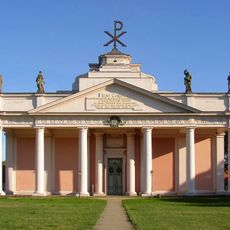
Ludwigslust Palace is a brick building clad in local sandstone, built on an E-plan foundation with a projecting three-bay central block. The central block uses the Corinthian order, while the wings use Ionic, and forty over-lifesize allegorical figures by Rudolf Kaplunger alternate with vases along the attic. The interiors are neoclassical, with the Goldener Saal rising through two storeys.
A hamlet called Klenow, first mentioned in the 14th century, passed to Christian Ludwig II in 1708; he planned a hunting seat there from 1721, and Johann Friedrich Künnecke built the first lodge in 1731–1735. After the Seven Years' War, Duke Friedrich had it rebuilt 1772–1776 by Johann Joachim Busch, and from 1765 to 1837 Ludwigslust served as the duchy's capital and main residence instead of Schwerin.
The Goldener Saal rises through two storeys of the central block, with a colossal order of Corinthian columns and ornament carried out in stucco and Ludwigsluster Carton, a mouldable paper-mâché. It is used today for summertime concerts. The name Ludwigslust ("Ludwig's joy") comes from Prince Christian Ludwig, who built the hunting lodge here.
The museum is open daily except Mondays, with guided tours available through the state rooms and exhibitions. Plan enough time to explore the interior, as there is much to see throughout the building.
The palace features Ludwigslust board, a special papier-mâché material used to replace traditional stucco and wooden ornaments throughout the rooms. This method was more economical and allowed decorative details to be created faster than with conventional craftsmanship.
The community of curious travelers
AroundUs brings together thousands of curated places, local tips, and hidden gems, enriched daily by 93,460 contributors worldwide.