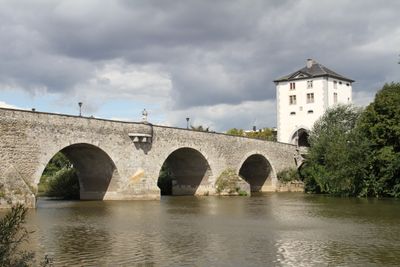
Alte Lahnbrücke, Stone arch bridge in Limburg, Germany
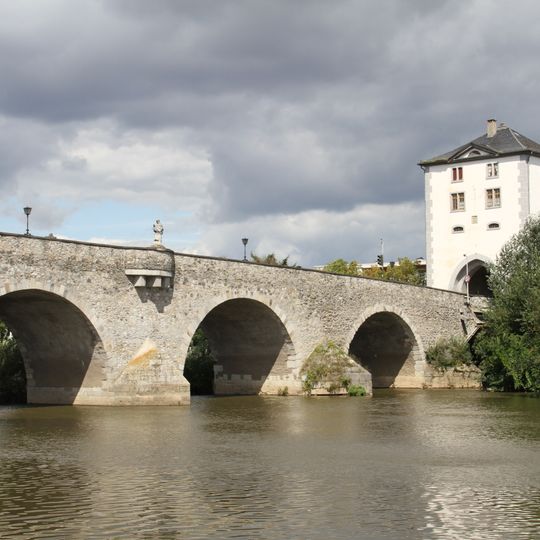
The Alte Lahnbrücke is a stone arch bridge with six arches, built from 1315 to 1354. Its total length is 106 metres, with arch spans between 12.14 and 14.58 metres. On the upstream side stands a stone figure of Saint John Nepomuk, and opposite it a stone cross donated by survivors of the 1349 plague. The outer bridge tower on the Westerwald side is the only surviving 14th-century bridge tower in Germany.
A wooden bridge existed by 1160, built by the priest Gottfried von Beselich, and was destroyed by Lahn floods in 1255 and 1306. The stone bridge was built from 1315 to 1354 with two towers and a width of about 6 metres. Archbishop Balduin of Luxembourg authorised a toll in 1344, confirmed by Emperor Charles IV in 1357 and levied until 1905. The bridge was partially blown up in 1945 and rebuilt in 1947/48.
The stone figure of Saint John Nepomuk, patron saint of bridges, was placed on the upstream side in 1966. Opposite it stands a stone cross donated by survivors of the 1349 plague. A carved head in the outer tower's passage is said in local legend to be a toll collector turned to stone for unjust levies.
The bridge carries a single narrowed lane through the surviving 14th-century tower, where a traffic light alternates direction. Walkers use the 2.6-metre side cantilevers added in 1947/48 and widened in 1982/83. The structure links the Innenstadt with the Westerwald bank; the New Lahn Bridge, about 200 metres downstream, now takes through traffic.
In the passage through the outer bridge tower, a stone head is set into the wall. Limburg legend identifies it as a toll collector who was cursed by a traveller for collecting tolls unlawfully and was turned to stone.
The community of curious travelers
AroundUs brings together thousands of curated places, local tips, and hidden gems, enriched daily by 93,644 contributors worldwide.