Oranienbaum Palace, Baroque palace in Oranienbaum, Oranienbaum-Wörlitz, Germany
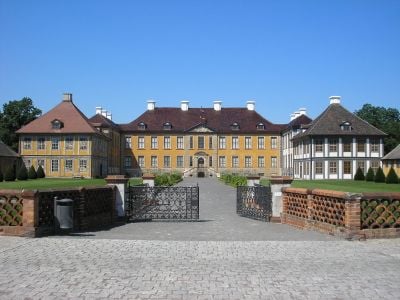
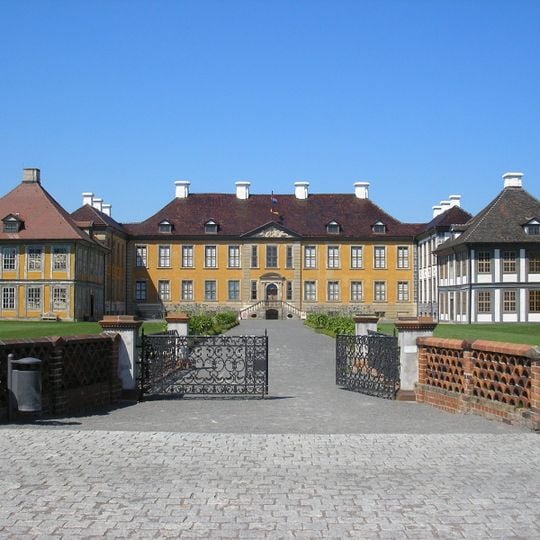
Oranienbaum Palace is a three-winged Baroque complex with a golden-yellow central block of two main storeys plus an attic, white-framed windows in regular rows and a dark grey mansard roof with dormer windows. Dark wrought-iron gates stand in a low brick wall with stone pillars and a rounded balustrade. A white wing with dark timber framing under a steep roof connects on the right.
Henriette Catharina of Orange-Nassau received the village of Nischwitz from her husband Johann Georg II in 1660 and renamed it Oranienbaum. The foundation stone of the palace was laid on 8 June 1683 to designs by Cornelis Ryckwaert; after Ryckwaert's death Johann Tobias Schuchart completed it between 1698 and 1702 as a widow's residence. In 1780 Leopold Friedrich Franz had the interiors and garden redesigned, and since 2003 the palace has been open to visitors.
The name Oranienbaum refers to Henriette Catharina of Orange; the town was called Nischwitz until she renamed it. Inside, look for the Fliesenkeller, a summer dining room lined with Delft ceramic tiles, and the Ledertapetensaal with gilded leather hangings. The Spiegelkristallsaal displays modern glass objects by the Dutch artist Bernhard Heesen.
The palace opened to visitors in 2003; the palace park is freely accessible, while the restored pagoda and the Chinese teahouse can be entered after prior registration. The orangery houses a café and a carriage exhibition, and a citrus garden lies beside it. North of the orangery stands the palace nursery laid out around 1790.
The 175-metre orangery in the southern part of the park was built in 1811 and has housed a citrus collection without interruption since then; a café and a carriage exhibition now occupy part of it, and a large garden of citrus plants lies beside it.
The community of curious travelers
AroundUs brings together thousands of curated places, local tips, and hidden gems, enriched daily by 93,984 contributors worldwide.