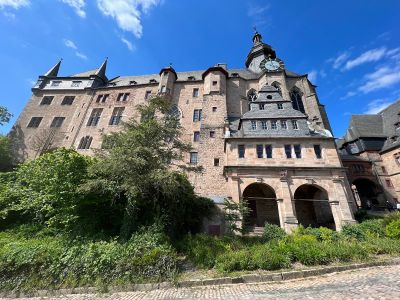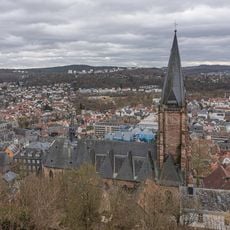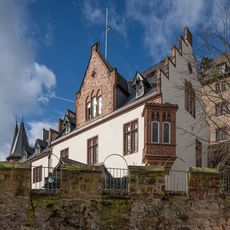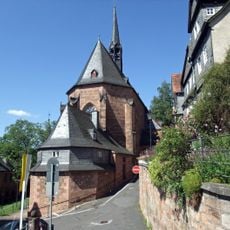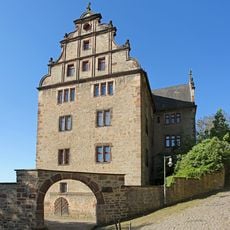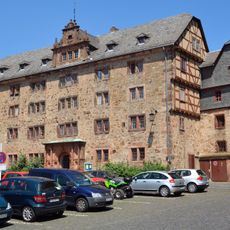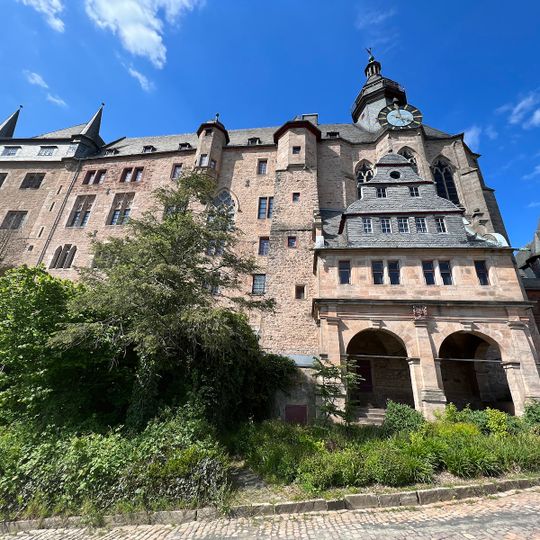
Marburg Castle, Medieval castle on Schlossberg hill in Marburg, Germany.
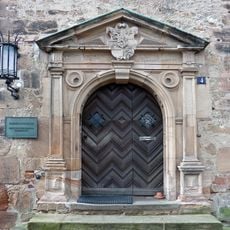
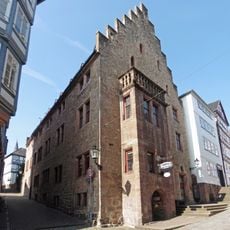
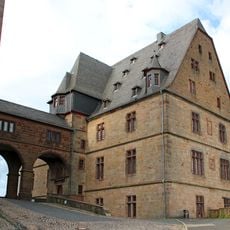
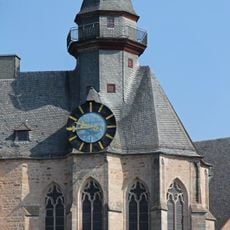
Marburg Castle, also called Landgrafenschloss, is a horseshoe-shaped complex around a narrow courtyard on the Schlossberg, 287 m above sea level west of the city. The Landgrafenbau with the castle chapel stands in the south, the Frauenbau or Kemenate in the west, and the Saal- or Fürstenbau with the Leutehaus in the north. The core dates from the 11th and 12th centuries, while the second half of the 13th century largely shapes the present appearance. The Fürstensaal is among the largest secular Gothic halls in Central Europe.
A fort stood on the Schlossberg by the 11th century; whether the Gisonen or the counts of Gleiberg held it is debated. Around 1140 a mint and market existed at Marburg under the Ludowingian landgraves of Thuringia, who renewed the castle. In the second half of the 13th century it was rebuilt, and it became the first residence of the Landgraviate of Hesse.
The castle's name comes from the Landgraves of Hesse, whose first residence it was; the great hall is still called the Fürstensaal, the Princes' Hall. Since 1981 the Wilhelmsbau has housed the Marburg University Museum of Cultural History. The Hessian State Theatre stages performances in the Princes' Hall, and guided tours also open the casemates and the Hexenturm.
Two footpaths climb from the Oberstadt to the south gate: the cobbled Landgraf-Philipp-Straße and the winding Ludwig-Bickell-Treppe. Bus line 10, the Schlossbus, runs up the Gisonenweg. The casemates and the Hexenturm can only be seen on a guided tour.
In 1529, the Marburg Colloquy took place here, a crucial meeting between Martin Luther and other Protestant reformers during the Reformation. This event made the castle an important location in European religious history.
The community of curious travelers
AroundUs brings together thousands of curated places, local tips, and hidden gems, enriched daily by 93,691 contributors worldwide.