Schönhausen Palace, Baroque palace in Niederschönhausen, Germany
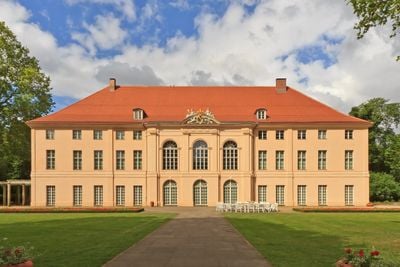
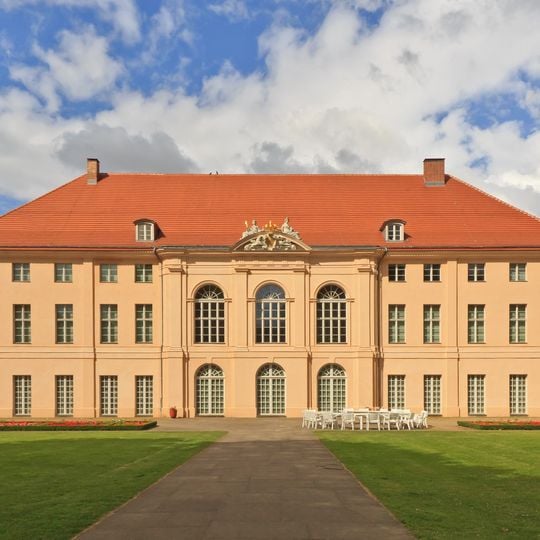
Schönhausen Palace is a long, symmetrical baroque building in pale peach-pink stucco beneath a steep red tiled roof with two dormer windows and two brick chimneys. Its facade has three levels of evenly spaced windows; the slightly projecting central section carries a sculpted crest, three tall arched windows on the main floor and three arched doorways below, while the wings have rectangular windows. A paved path crosses a lawn in front. Johann Arnold Nering designed the three-winged core, and Johann Boumann raised the side wings to the height of the main building after 1764.
The building was constructed between 1691 and 1693 for Frederick I of Prussia as a royal residence. It later served from 1949 to 1960 as the official seat of the president of the German Democratic Republic.
The palace's name, Schönhausen, means "beautiful houses" and refers to the estate's original Dutch-style manor. Visitors can see Rococo stucco work attributed to Johann Michael Graff on the ground floor, while the upper floor preserves the GDR state guest apartment and Wilhelm Pieck's study. A plaque in the outbuildings commemorates the Round Table talks of 1989–1990 and the negotiations on the Two Plus Four Treaty.
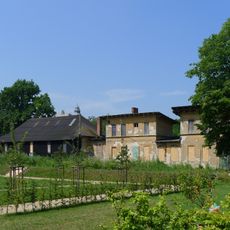
The palace has been open to visitors as a museum since 19 December 2009. The grounds are split by a wall into an inner garden and a public outer park, and the Panke flows through the park. The outbuildings, including the garages under monument protection, are not yet open.
A hill in the palace gardens was long said to be the grave of Condé, Frederick the Great's favourite horse. The horse actually outlived the king and died in 1804 at the age of 38; its skeleton is kept at the veterinary department of the Free University of Berlin.
The community of curious travelers
AroundUs brings together thousands of curated places, local tips, and hidden gems, enriched daily by 94,036 contributors worldwide.