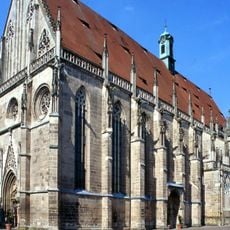
Protestant Augustine Church, Baroque church in Schwäbisch Gmünd, Germany.
The Augustinuskirche in Schwäbisch Gmünd is the former monastery church of the town's Augustinian Hermits, given a Baroque form in 1756–1758 under city architect Johann Michael Keller, who had part of the late-Gothic building demolished. Its grey facade carries a tall arched window with a yellow border, and a small octagonal cupola with a green cap and cross sits on the steep dark roof. Yellow two-storey annexes with red tiled roofs join the church at an inner corner.
Augustinian hermits settled in Schwäbisch Gmünd from 1284, and their monastery is documented from 1308. The church's late Gothic choir was rebuilt in 1432; after the monastery was judged near collapse, a Baroque new monastery was finished in 1747. From 1756 Johann Michael Keller rebuilt the church, partly demolishing the Gothic structure, and the work was completed in 1758. In 1806 it became a Protestant garrison church, in 1817 the town parish church.
The church was founded by Augustinian hermits and continues to serve as a center for religious life in the town. Visitors experience the baroque interior during services, seeing how the space functions as a place of worship rather than merely as a monument.
The church stands next to the Heilig-Kreuz-Münster in the old town centre. A doorway at the apex of the choir, broken through from the Münsterplatz in 1855 to add seats for garrison members, was walled up again during the 1963 restoration, so entry is no longer through that side.
The octagonal roof turret holds two bells, not a full peal: the older one was cast in 1790 by Johann Ernst Lösch of Crailsheim and came from the Ritterstift Comburg; the second was cast in 1952 by Heinrich Kurtz of Stuttgart and donated by parishioners.
The community of curious travelers
AroundUs brings together thousands of curated places, local tips, and hidden gems, enriched daily by 94,100 contributors worldwide.