Barfüsserkirche, Church building in Augsburg, Germany.
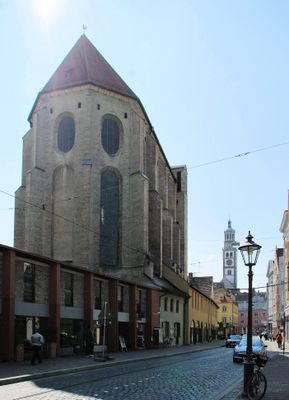
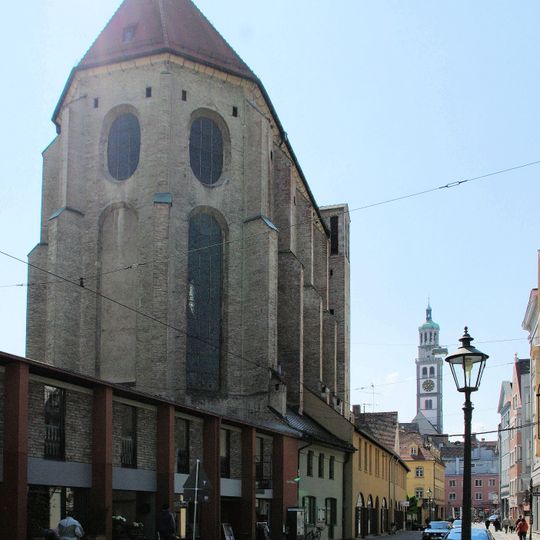
The Barfüsserkirche is a tall, towerless church of grey-brown brick in Augsburg's Lechviertel. Its steep hipped roof of reddish-brown tiles has a small square opening near the peak. The front facade shows two round-arched openings high up, a very tall central arched window below them, and a lower arcade of dark brick with rectangular openings at street level. Slender buttresses divide the side wall.
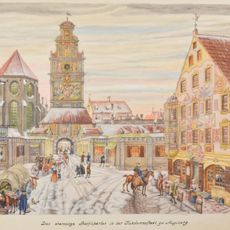
Franciscans sent to Germany in 1221 reached Augsburg that October and built a small church here in 1243. A fire destroyed the Romanesque successor of 1265, and from 1407 to 1411 the church was rebuilt as a Gothic basilica on the old foundations, consecrated on 23 August 1411. After the friars left, it became Augsburg's first Protestant church in 1535; British air raids on 25–26 February 1944 left only the masonry choir, and services resumed at Easter 1949.
The church is Bertolt Brecht's baptismal church. Its name comes from the Franciscans, called Barfüßer (barefoot friars), who built it. The 1760 choir grille and Georg Petel's Christ Child were saved from the 1944 fire and are back in the church.
The church stands in Augsburg's Lechviertel, next to the former Barfüßertor site. The rear nave was not rebuilt after 1944; in its place a green inner courtyard is open to the public. The surviving choir holds the restored 1760 choir screen and the Christ Child by Georg Petel.
The church is the baptismal church of Bertolt Brecht. In 2013, part of the Barfüßer archive, believed lost since 1944, was rediscovered by chance in an old cupboard in the attic.
The community of curious travelers
AroundUs brings together thousands of curated places, local tips, and hidden gems, enriched daily by 94,865 contributors worldwide.