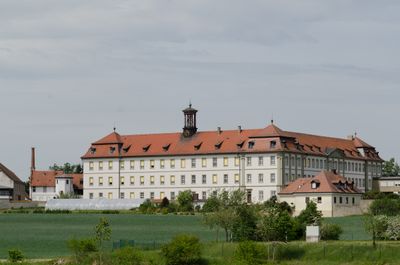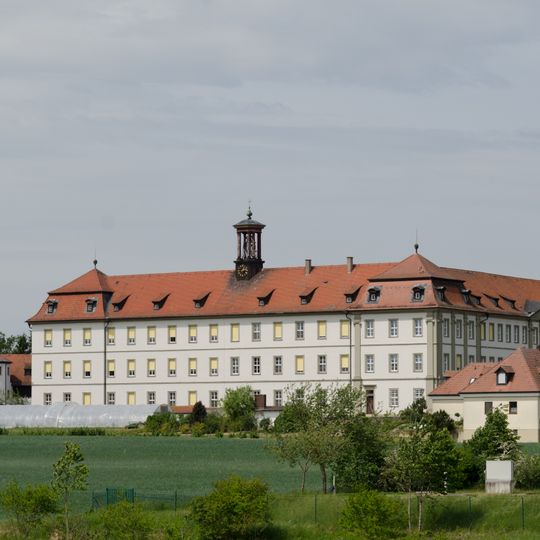
Kloster Heidenfeld, Monastery of the Sisters of the Redeemer in Röthlein, Bavaria, Germany
Kloster Heidenfeld, also called Kloster Maria Hilf, is a former Augustinian Canons' monastery in Heidenfeld, part of Röthlein in Lower Franconia. Since 1901 it has belonged to the Congregation of the Sisters of the Redeemer. The baroque convent building was designed by Balthasar Neumann between 1723 and 1733; its three-storey staircase and stuccoed main hall on the second floor survive, while the church was demolished in 1805.
Countess Alberada and her husband Hermann II of Kastl donated land in 1069; Bishop Adalbero of Würzburg passed it to Augustinian Canons in 1071. The monastery was destroyed in 1525 and 1553/54 and rebuilt. Balthasar Neumann planned the baroque convent between 1723 and 1733. Secularized in 1803, the church was demolished in 1805; the Sisters of the Redeemer acquired the remaining buildings in 1901.
The monastery is also called Kloster Maria Hilf, and since 1901 it has belonged to the Congregation of the Sisters of the Redeemer, founded in 1866. The sisters ran it as a rest home and then as a nursing home for elderly members of the congregation. The order announced its closure for autumn 2021 due to a lack of new members.
The complex lies in Heidenfeld, part of Röthlein, just south of Schweinfurt. The Sisters of the Redeemer announced the closure of the convent for autumn 2021 due to a lack of new members, so access to the buildings and former nursing home should be checked before visiting.
The monastery belonged to the Sisters of the Redeemer, a congregation founded in 1866, from 1901 until its dissolution in autumn 2021 due to a lack of new members. The south wing added in 1935 closed the gap left by the demolished church and contains a chapel with a baroque altar.
The community of curious travelers
AroundUs brings together thousands of curated places, local tips, and hidden gems, enriched daily by 94,840 contributors worldwide.