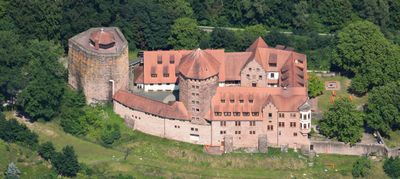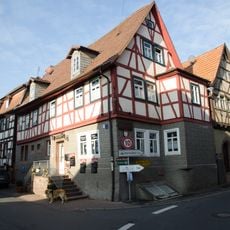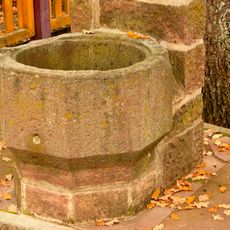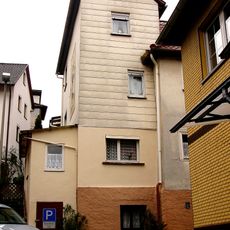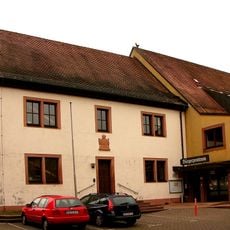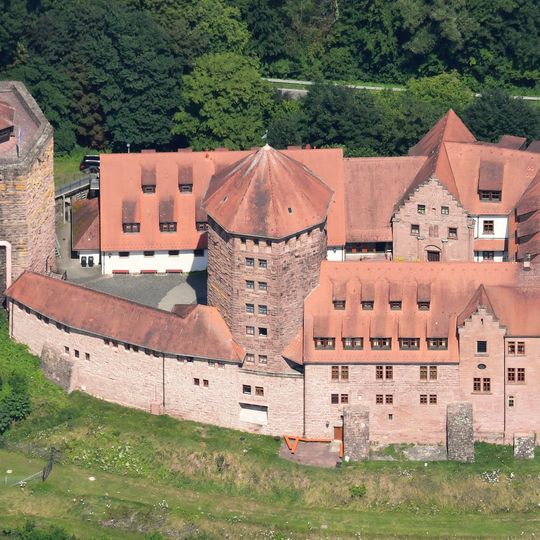
Burg Rieneck, Hill castle in Rieneck, Bavaria, Germany
Burg Rieneck is a hill castle above the Sinn valley in Rieneck, Bavaria. Its keep, the 19-metre Dicken Turm, has an irregular seven-sided plan with walls 4 to 8 metres thick and no original ground-level entrance. The courtyard was once lined with half-timbered living quarters, storehouses and stables, of which the vaulted cellar survives.
Ludwig I, Count of Loon and Rieneck, built the castrum Rinecke around 1150 to secure his territory against Mainz, Würzburg and Fulda. In 1188 the castle was named in a marriage contract between Emperor Frederick I and King Alfonso VIII of Castile, as part of the bride's dowry. When the Rieneck line died out in 1559, the castle passed to a condominium held three-quarters by Mainz and one-quarter by Hanau.
The castle's name comes from the Counts of Rieneck, whose line died out with Count Philipp III on 3 September 1559. The Romanesque court chapel survives only in parts of its portal, and two figure slabs from around 1300 on the outer facade have an unexplained origin. Since the 20th century the castle has served as a youth castle for the Association of Christian Guides and Scouts (VCP).
The castle now operates as an international education and meeting center managed by the Association of Christian Scouts, serving youth groups and other organizations. Visitor access depends on scheduled activities and group bookings, so advance coordination is recommended before planning a visit.
The keep, the 19-metre Dicken Turm, has no ground-level entrance; the current doorway was cut in the 19th century. Its original two entrances opened on upper floors and were reached by wooden stairs along the outer wall that could be removed quickly in an attack.
The community of curious travelers
AroundUs brings together thousands of curated places, local tips, and hidden gems, enriched daily by 93,248 contributors worldwide.