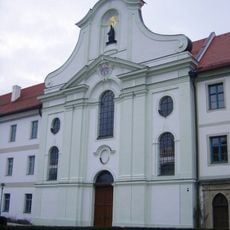
Rott Abbey, Benedictine monastery in Rott am Inn, Germany.
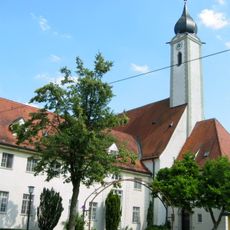
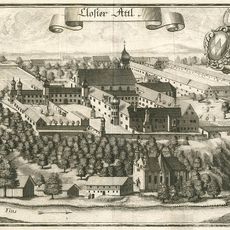
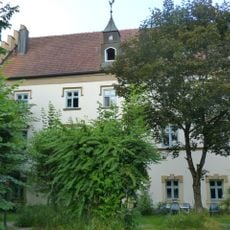
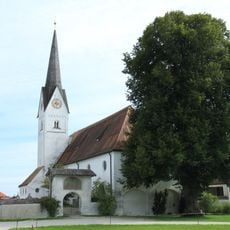
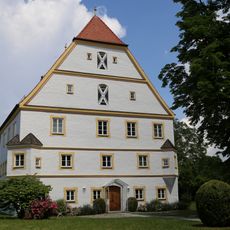
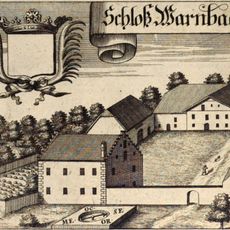
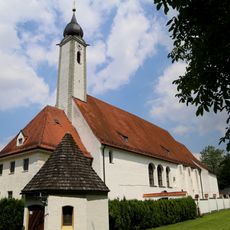
Rott Abbey is a former Benedictine monastery in Rott am Inn, Bavaria. Its abbey church, St. Marinus and Anianus, was rebuilt in Rococo style by Johann Michael Fischer from 1759 to 1763, replacing a Romanesque basilica. The church has a domed crossing and altars with sculptures by Ignaz Günther. The remaining west wing housed a brewery from 1650, later owned by Georg Kaiser.
Around 1073, Count Kuno I of Rott planned a monastery on his family estate, and the foundation was renewed in 1081 after his son Kuno II died childless at the Battle of Höchstädt. The Benedictine abbey was dissolved in Bavaria's secularisation of 1803, when buildings were demolished or sold and the library dispersed. A fire destroyed surviving parts in 1937, but the abbey church survived.
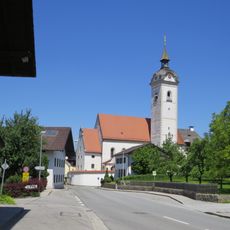
The abbey church, dedicated to Saints Marinus and Anianus, has served as the parish church of Rott am Inn since the monastery was dissolved in 1803. Its furnishings were created between 1759 and 1791 by a single workshop circle of South German Rococo artists, led by architect Johann Michael Fischer and sculptor Ignaz Günther. The high altar was enlarged beyond the original design with statues of Emperor Henry II and his wife Cunigunde.
The site is located in the Bavarian town of Rott am Inn and can be explored on foot. Informational displays at the location explain the history and help you understand the different areas of the complex.
The high altar was carved by Ignaz Günther, whose white and partly polychrome figures are counted among the finest German sculpture of the 18th century. It was set up provisionally in November 1761 and later enlarged with statues of Emperor Henry II and his wife Cunigunde. Günther is buried here.
The community of curious travelers
AroundUs brings together thousands of curated places, local tips, and hidden gems, enriched daily by 93,228 contributors worldwide.