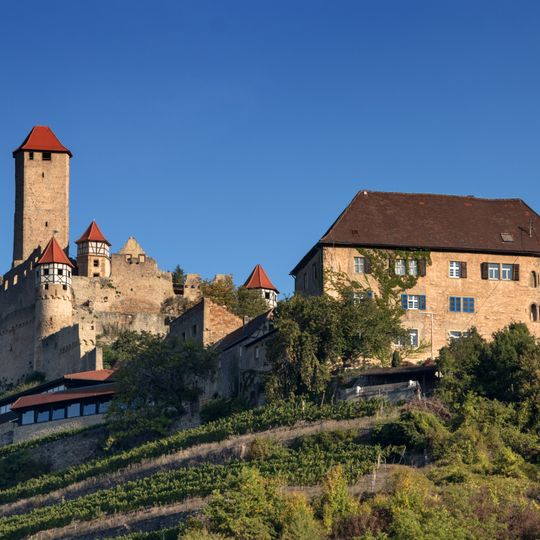
Hornberg Castle, Medieval castle in Neckarzimmern, Germany
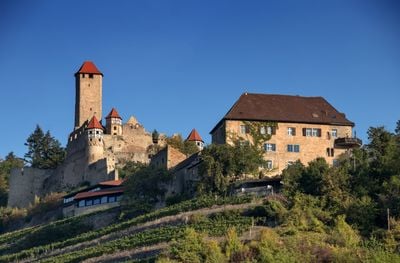
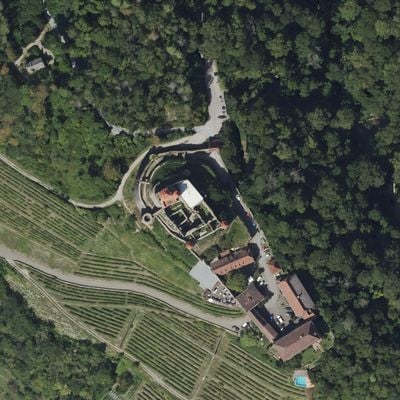
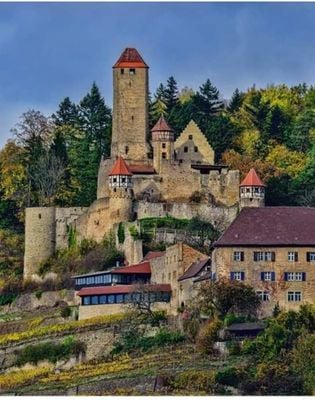
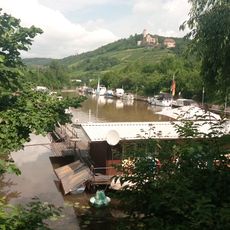
Hornberg Castle stretches 170 m along a steep spur above the Neckar. Its lower castle holds the Romanesque tower palace, probably built in the mid-12th century; the upper castle has a shield wall, keep, chapel and palace. Around 1510 Conz Schott von Schottenstein enclosed both castles and the shared outer bailey with one wall, still visible today.
The castle was first documented in 1184, when the Counts of Lauffen owned it, though it was likely founded in the 11th century. Götz von Berlichingen bought it in 1517 for 6,500 guilders and lived there until his death in 1562. It was uninhabited from 1738 and left to decay until 1825, when it was partially restored. A museum opened in 1968.
The name comes from the rocky outcrop on which it was built, and it remains a defining landmark in the Neckar Valley. Visitors experience how medieval living spaces and defensive structures were merged into one functional compound.
The castle stands on a steep spur 228.6 m above sea level, reached on foot from Neckarzimmern; the climb is short but steady. The complex stretches 170 m from the lower Romanesque tower palace to the upper castle with its shield wall, keep and chapel, so allow time to walk the whole length. The museum opened in 1968 and displays the original armour of Götz von Berlichingen.
The castle has housed a museum since 1968, displaying weapons and armour from the Middle Ages, including the original armour of Götz von Berlichingen, alongside a documentation of the castle's history. The complex stretches 170 m in length and was formed from two separate castles joined by a common wall around 1510.
The community of curious travelers
AroundUs brings together thousands of curated places, local tips, and hidden gems, enriched daily by 93,200 contributors worldwide.