Golden Cone of Ezelsdorf-Buch, Bronze Age ceremonial headpiece at Germanisches Nationalmuseum, Germany.
The Golden Cone of Ezelsdorf-Buch is a Late Bronze Age cone made of thin gold sheet, now 88.3 cm high after reconstruction, with a long slender shaft and a bulging foot edged by a bronze ring. Its surface carries 154 horizontal bands of punched motifs, including circle bosses, eye-shaped ovals, eight-spoked wheels and miniature cones. The original brim is missing.
The piece was found in 1953 during earthworks between the villages of Ezelsdorf and Buch in Bavaria and dates from around 1000 to 900 BCE. It belongs to a small group of four similar golden hats found across Central Europe.
The cone is covered in rows of punched circles, eye-like shapes, and small raised cones that run across its entire surface. These patterns point to ritual use, likely connected to the sky or supernatural forces in ways that are still debated today.
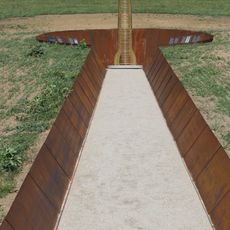
The cone is displayed at the Germanisches Nationalmuseum in Nuremberg. The findspot lies at the foot of the 576 m Brentenberg, on the boundary between Ezelsdorf and Buch near Neumarkt in der Oberpfalz; the published coordinates are about 11°21'59" E, 49°19'38" N. Nothing of the original burial pit is marked there today.
The cone's decoration includes miniature cone shapes in rows 105 and 127, a motif found on no other golden hat. The finder initially hacked the object apart with digging tools, and it was his wife who collected the gold-shining scraps and took them to a dentist, whose melting test confirmed solid gold.
The community of curious travelers
AroundUs brings together thousands of curated places, local tips, and hidden gems, enriched daily by 94,523 contributors worldwide.