Branitz park, English garden in Cottbus, Germany
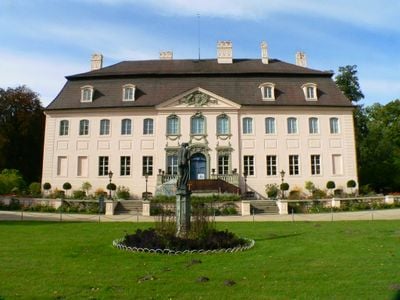
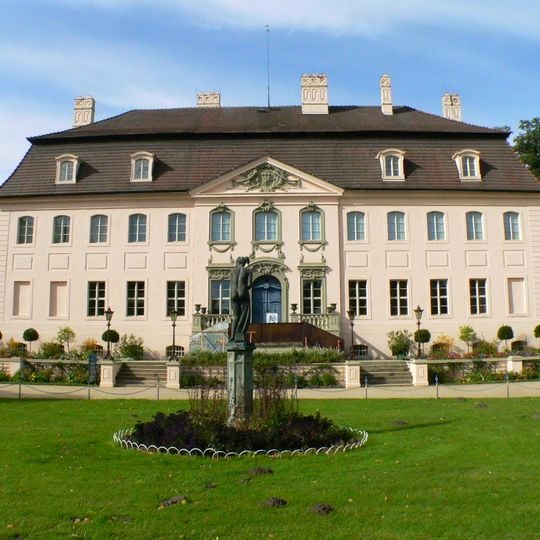
Branitzer Park is a 622-hectare English landscape park in Cottbus, begun in 1846 by Prince Hermann von Pückler-Muskau. At its centre stands Schloss Branitz, a three-storey cream building with a dark hipped roof, dormer windows and a central pedimented section; a stone statue on a plinth faces the arched doorway. The park is divided into Pleasureground, inner park and outer park.
The Pückler family acquired the Branitz estate in 1696; in 1785 they moved to Muskau and Branitz was leased out. After selling Muskau in April 1845 for financial reasons, Hermann von Pückler-Muskau began laying out an English landscape park at Branitz in 1846 and moved into the rebuilt Schloss with Lucie in 1852. His step-cousin Heinrich von Pückler later made far-reaching changes, with head gardener Georg Bleyer directing the work.
The park's Lower Sorbian name is Rogeński park, and the surrounding district of Branitz belongs to Cottbus. In the grounds, visitors can see the two earth pyramids: the Seepyramide, built 1856–1857 on an artificial island in the lake, holds the graves of Pückler and his wife Lucie, while the stepped Landpyramide stands southeast of the lake. Schloss Branitz displays paintings by Carl Blechen, born in Cottbus.
The different zones of the park are linked by paths and bridges that allow a walk of several kilometers, offering changing landscape impressions along the way. Anyone wanting to experience the entire grounds should plan several hours and wear comfortable shoes.
Two earth pyramids rise from the flat terrain, with the lake pyramid on an island serving as the final resting place of the count. The water moat surrounding this structure gives it a special appearance that stands apart from the castle area.
The community of curious travelers
AroundUs brings together thousands of curated places, local tips, and hidden gems, enriched daily by 93,319 contributors worldwide.