Augustusburg Hunting Lodge, Renaissance hunting lodge in Augustusburg, Germany
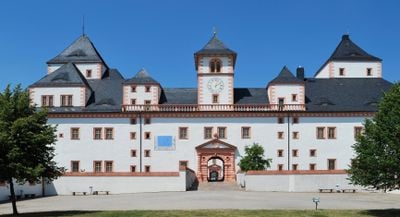
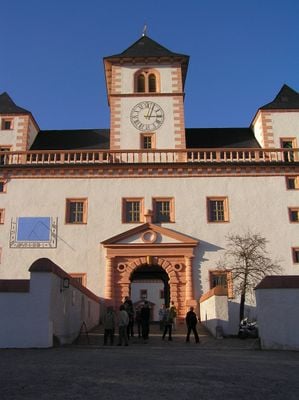
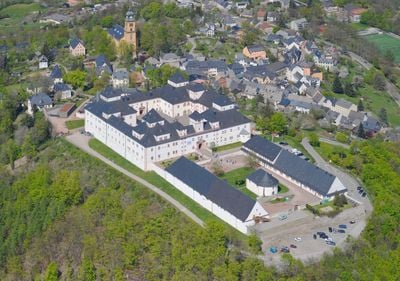
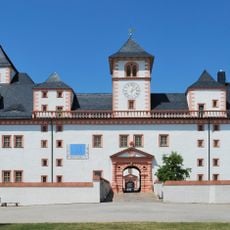
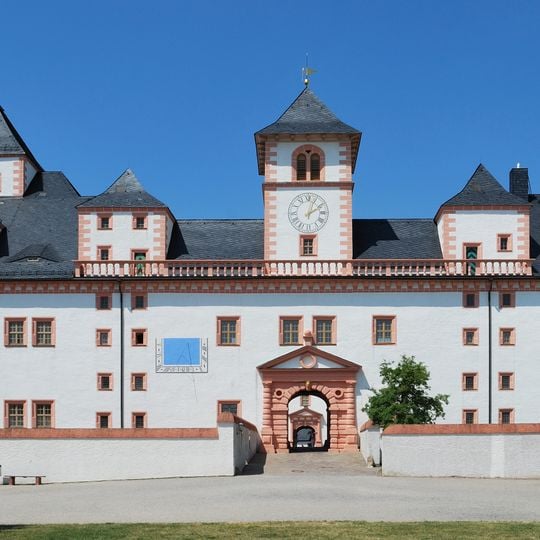
Augustusburg is a Renaissance hunting lodge built 1568–1572 on the Schellenberg hill above the town of Augustusburg. Its core is four two-storey corner houses around a square courtyard, joined by the chapel and three lower intermediate wings, with a gatehouse to the north. The white plastered facade carries red-painted stone trim, a central square clock tower with Roman numerals, a balustraded gallery on red pillars, and a pale blue sundial on the left wing.
Elector Augustus commissioned construction between 1568 and 1572, replacing an earlier castle that had stood on the hilltop. The structure reflects Renaissance building traditions and evolved with new functions as time progressed.
The lodge is named after Elector Augustus of Saxony, who ordered it built from 1568. Its four corner houses are named Hasen-, Linden-, Sommer- and Küchenhaus, and the chapel holds an altar painting that may show the earlier Schellenberg castle. A sandstone figure of a Hunter with Dog, carved around 1600 by Conrad Buchau, stands in the staircase of the hunting museum.
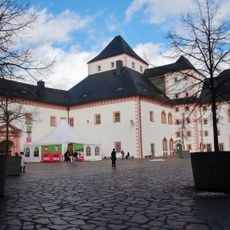
The lodge stands on the Schellenberg at 516 m, 12 km east of Chemnitz; the core castle is arranged around a square courtyard, with the gatehouse on the north access side and utility wings to the south. The museums, restaurants and youth hostel are inside the castle itself, so allow time to move between the separate collections. The sandstone figure of a hunter with dog stands in the staircase of the hunting-animal museum.
The motorcycle museum within the castle displays one of the first series-produced motorcycles ever made, offering insight into early motorization history. This unexpected collection bridges Renaissance heritage with a modern chapter of technical development.
The community of curious travelers
AroundUs brings together thousands of curated places, local tips, and hidden gems, enriched daily by 94,706 contributors worldwide.