Burg Baesweiler, Medieval castle in Baesweiler, Germany.
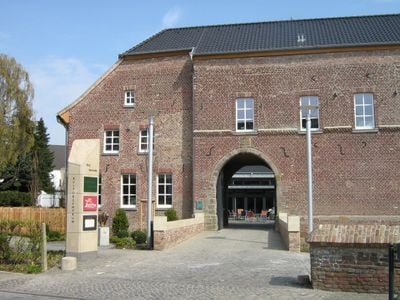
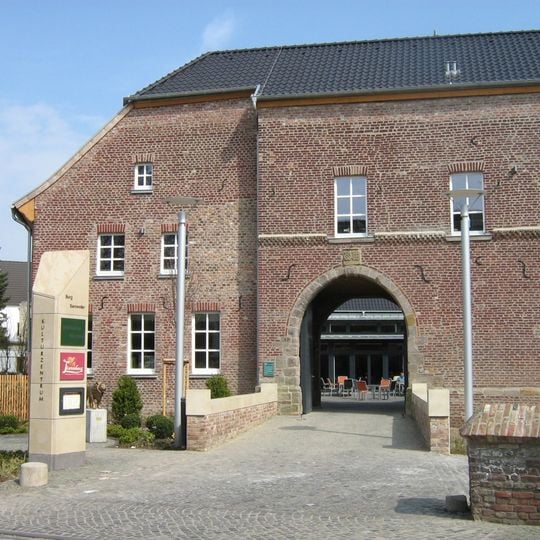
Burg Baesweiler is a two-storey, four-wing brick castle on a trapezoidal plan in central Baesweiler, built around a paved courtyard. A stone bridge leads to the pointed-arch main portal, framed in bluestone and crowned with the coats of arms of the von Randerath and von Schilling families. The oldest part is a plain 16th-century dwelling with corner quoins, next to an octagonal stair tower.
This fortress was built in medieval times and served as a seat of power and military defense for local noble families during territorial struggles in the region. The structure shows evidence of multiple construction phases and reinforcements added over several centuries as military needs changed.
Since March 2006 the castle has served as Baesweiler's cultural centre, housing the town library, a collection of knight's armour and a gastronomy area. Regular events include cabaret, concerts, exhibitions and Kommunalkino film screenings. A metal lion sculpture, the emblem of both castle and town, stands as its landmark.
The complex sits in Baesweiler's town centre, entered through the pointed-arch main portal crowned with the coats of arms of the von Randerath and von Schilling families; a stone bridge leads to it. Since March 2006 the wings have housed the town library, a collection of knight's armour and a gastronomy area, so parts are in everyday public use. Look for the pale stone pillar with the "KUTTUREUM" plaque at the corner.
The two ink-and-quill drawings by Renier Roidkin from 1726 show that the manor house once had narrow, stone-framed arrow slits facing the gate; these were later replaced by windows. The building also kept a small block frieze, now only partly preserved because larger windows were cut into it.
The community of curious travelers
AroundUs brings together thousands of curated places, local tips, and hidden gems, enriched daily by 93,766 contributors worldwide.