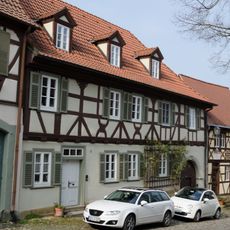
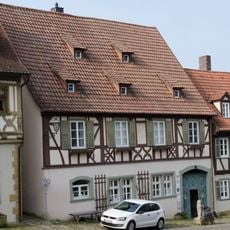
Burg, Medieval castle ruins in Königsberg, Germany.
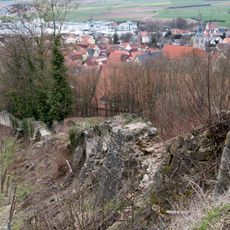
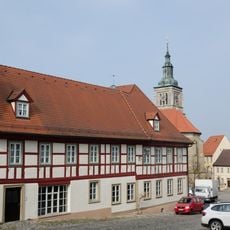
Burg is a medieval castle ruin sitting on a 355-meter (1,165-foot) high hill that overlooks the historic old town, with stone walls connecting down to Saint Josef Church. The grounds today form an open area with a restaurant, parking facilities, and pathways through visible foundation walls and defensive structures.
The castle's exact origins are unknown; the claim that it was built after Bramberg Castle fell in 1168 is unproven. A royal Schultheiß is first documented in 1234, indicating an imperial castle. In 1243 Emperor Frederick II granted Königsberg and Bettenburg to the Bishop of Bamberg, who pledged them to Count Hermann I of Henneberg in 1249; they stayed with the Hennebergs until passing by marriage to Burgrave Albrecht of Nuremberg in the 14th century.
The castle association that maintains the ruin asks visitors for a voluntary donation to see the viewing tower and the castle well. Since the grounds are easy to walk, the annual rose and garden fair draws hundreds of visitors to Königsberg. A notice board prepared by castle researcher Joachim Zeune has stood near the ruin since autumn 2012.
The grounds are open year-round and invite walks through the ruins at your own pace. Wear sturdy shoes since the path up the hill is steep and the terrain is uneven in places.
The castle well was measured at 80 meters deep after being cleaned in the 1920s and 1930s; debris has since reduced its depth. A lamp now lets visitors see down the shaft, which holds water only after heavy rain. Its unusually wide diameter and precise construction are notable.
The community of curious travelers
AroundUs brings together thousands of curated places, local tips, and hidden gems, enriched daily by 94,663 contributors worldwide.