Burg Körse, Medieval castle ruins on Schlossberg, Schirgiswalde-Kirschau, Germany.
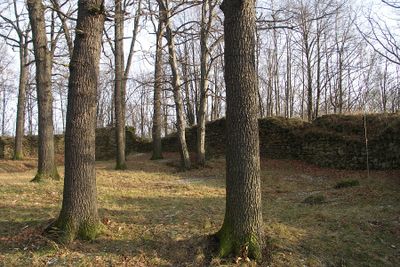
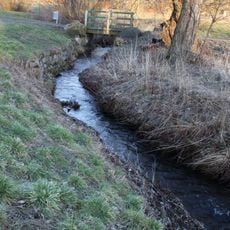
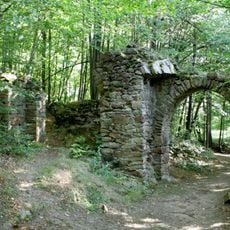
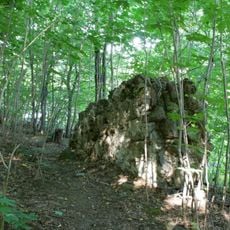
Burg Körse is a ruined hilltop castle on a granite spur at 275 m above sea level, encircled on three sides by the Spree river in Kirschau. Its surviving half-round ring wall, about 100 m long and still up to 3 m high, enclosed the main castle; the gate arch of the outer bailey also remains. The site once had a keep, a drawbridge, four gates and bastions, built of local granite and basalt from Halbendorf.
Around 1000, Lusatian Sorbs built a rampart on the rock spur above the Spree loop, named Korzym after its founder. German settlers destroyed it around 1100, and between 1200 and 1250 a castle with a main bailey, outer bailey and at least three gates replaced it. In November 1352 the Upper Lusatian Six Cities League took and razed it on the orders of Emperor Charles IV; it was never rebuilt.
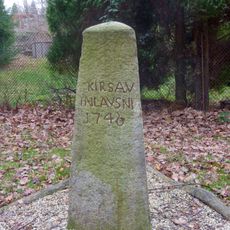
The name Körse derives from the Sorbian personal name Korz, after whom the original stronghold was called Korzym. The German castle built on the site between 1200 and 1250 kept a form of that Sorbian name. The Dreiländerstein still marks where the land of Budissin, the Kingdom of Bohemia and the Bishopric of Meissen met from 1200.
The site is accessible via hiking trails that lead to different sections of the medieval fortification and remain open to the public without entry fees. Sturdy shoes are recommended as the paths are uneven and the terrain has varying elevations.
The single written record of Burg Körse is a Zittau council annals entry by Johannes von Guben: in November 1352 the town took and destroyed "the house called the Körse" on the order of Emperor Charles IV, with Duke Volke of Schweidnitz as captain in the field.
The community of curious travelers
AroundUs brings together thousands of curated places, local tips, and hidden gems, enriched daily by 93,620 contributors worldwide.