Abbey of Sauvelade, Cistercian abbey in Sauvelade, France.
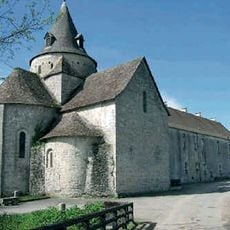
The abbey of Sauvelade is a Cistercian monastery built with a Greek cross floor plan and a central dome that follows classical monastic design principles. The structure displays the strict architectural conventions typical of this religious order and its distinctive spatial arrangement.
Gaston IV of Béarn founded this monastery in 1127, establishing it as an important religious center. It burned during the Wars of Religion in 1569 and was subsequently used as a Protestant temple, reflecting the region's troubled religious past.
The church contains a holy water basin resting on a green marble column from Roman times, its capital adorned with carved leaf patterns that speak to past civilizations. These repurposed ancient elements reveal how earlier construction traditions were woven into the abbey's design.
The monastery sits along a major pilgrimage route toward Santiago de Compostela, making it accessible to visitors following this historic path. Group tours can be arranged in advance to receive detailed information about the site's architecture and past.
The monastery marks a significant point on the Jacobus Route, one of the main paths for pilgrims traveling to Santiago de Compostela in Spain. This historical role makes it meaningful for anyone retracing the medieval pilgrimage ways of Europe.
The community of curious travelers
AroundUs brings together thousands of curated places, local tips, and hidden gems, enriched daily by 91,481 contributors worldwide.